Automating Customer Engagement: Practical Use Cases for Marketing

Marketing automation is easy to buy and easy to misuse. The tools will send anything to anyone on any trigger, which means the constraint is judgement rather than capability.
What follows is which flows are worth building, in what order, and the three things that quietly ruin otherwise sensible programmes: consent, deliverability and frequency.
The rule that comes before any of it
Automate a process after it works when a person does it.
If a human sending a follow-up by hand converts nobody, automating that follow-up produces the same failure at higher volume, greater cost and more difficulty changing it. Run the sequence manually for a few weeks. Find the version that works. Then build it.
Building first means debugging the content and the logic at the same time, inside a system where every change requires a deployment. That is the ordinary reason automation programmes stall six months in.
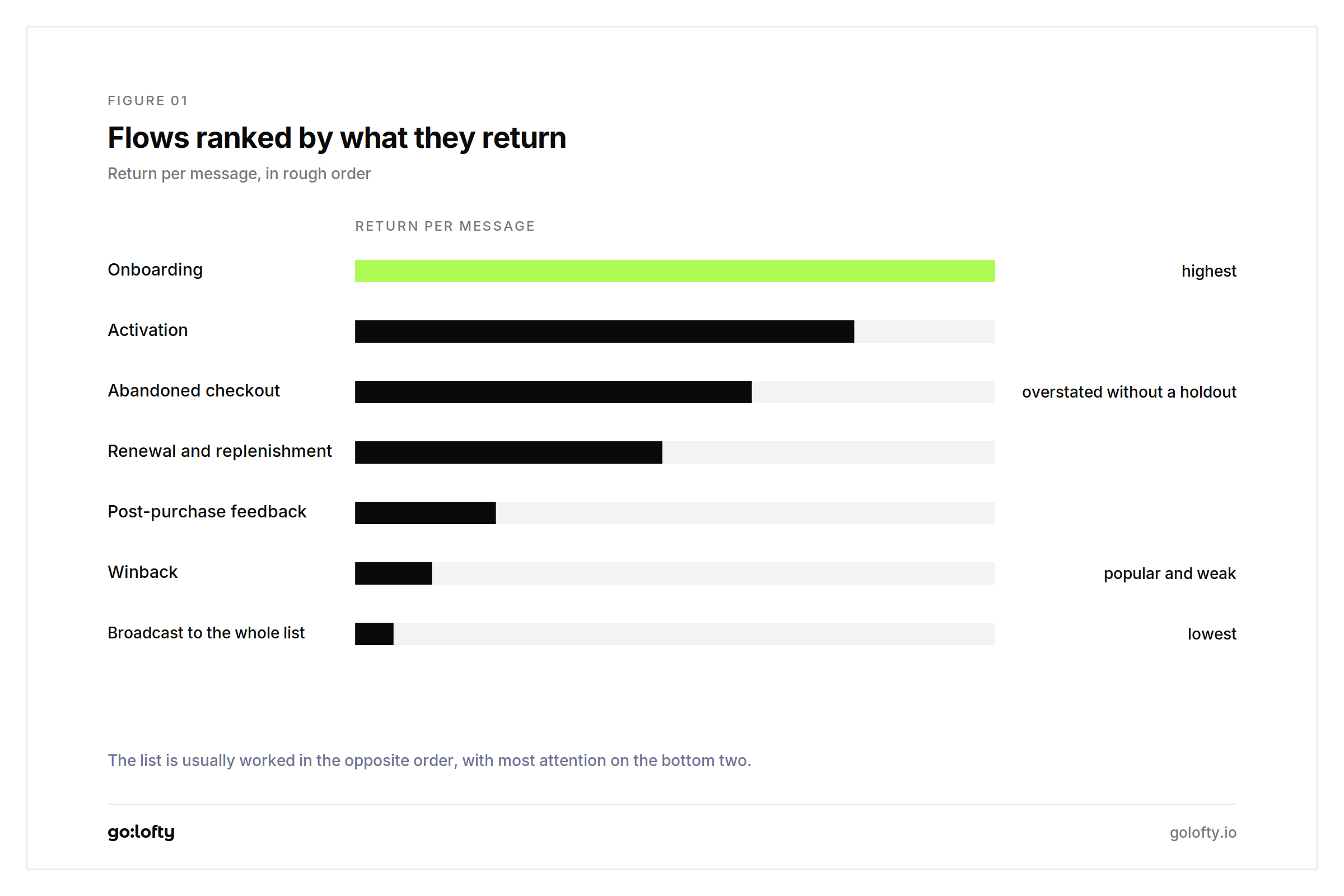
Flows ranked by what they return
Onboarding. The highest-return flow in most businesses, because early experience determines retention more than anything that happens later. The purpose is not welcoming people; it is getting them to a first useful result. Content should be sequenced against the steps that actually predict retention, which requires knowing what those steps are.
Activation. For customers who signed up and have not yet reached first value. Distinct from onboarding because it is triggered by absence rather than by time, and it is the flow most often missing entirely.
Abandoned checkout. Intent is already demonstrated, which is why it converts. Worth noting that a meaningful share of those people were returning anyway, so the measured effect overstates the real one unless it is held out.
Renewal and replenishment. Timing rather than persuasion. A reminder when a subscription approaches renewal or a consumable is likely to run out is useful to the customer and cheap to run.
Post-purchase feedback. Low direct return, useful as an input, and it degrades quickly if sent after every interaction.
Winback. Popular and weak. Customers who have genuinely left rarely return because of an email, and those who respond are often the ones who would have returned anyway. Measured against a holdout, winback flows commonly show negligible incremental effect while consuming send volume and depressing engagement rates.
Broadcast campaigns to the whole list. Lowest return per message and usually the largest share of the team's attention.
Consent
In the EU, electronic direct marketing generally requires prior consent under the ePrivacy rules. A narrow exception allows a business to market similar products to its own existing customers, provided an opt-out was offered when the contact details were collected and is offered in every subsequent message.
Consent has to be specific, informed and recorded, and separate purposes require separate permission. Consent to receive a newsletter is not consent to behavioural profiling.
The practical consequence for automation is that the addressable population is smaller than the database, and building flows against the full list produces both legal exposure and the deliverability problem described next. This is a summary rather than legal advice, and local implementations vary.
Deliverability, which automation quietly destroys
The mechanism is not widely understood and the damage is severe.
Mailbox providers decide what reaches the inbox partly on engagement. Repeatedly sending to people who never open teaches them that your mail is unwanted, and that judgement attaches to your sending domain rather than to the individual campaign.
The consequence is that a high-volume automated programme aimed at an unengaged list degrades delivery of the messages that matter, including transactional and service mail. Companies discover this when their most engaged customers stop receiving things, and they usually diagnose it as a content problem.
What protects against it: authenticate properly with SPF, DKIM and DMARC; suppress contacts who have not engaged in six to twelve months, which feels like discarding an asset and protects a larger one; and read a rising unsubscribe rate as information about the programme rather than about the list.
Frequency capping
Each flow is designed on its own and fires on its own. A customer can therefore trigger five separately sensible flows in a day and receive five messages, none of which knows the others exist.
A frequency cap applies across the whole programme rather than within each flow, along with a priority order determining which message wins when several are eligible.
This is the most common cause of unsubscribes in an otherwise well-built programme, and it is invisible when flows are reviewed individually, which is how they are always reviewed.
Measurement
Hold out a random portion of eligible customers from each flow.
Without a holdout, an abandoned checkout flow receives credit for every purchase that follows it. Some of those purchases were always going to happen. The flow may still be worth running, and the reported figure will be considerably larger than the real one.
Per-flow holdouts are more useful than one programme-level holdout, because they show which specific flows earn their place. It is common to find that two flows produce nearly all the incremental revenue and the remaining six produce send volume.
Measure incremental revenue and margin. Open and click rates move easily and correlate weakly with money.
What AI actually contributes
Useful: drafting message variants for a person to edit, which saves real time; summarising open-ended feedback at volume; modest gains from send-time optimisation.
Unreliable: sentiment scoring on short text, which is confident and frequently wrong, and should not drive action on its own.
Counterproductive: generating large volumes of content to fill a system capable of delivering many variants. That produces the stale-variant problem, where the machinery can deliver a hundred versions and the team can maintain eight.
What none of it addresses is the common underlying problem, which is that the messages are not worth sending. Generating more of them faster makes that worse rather than better.
How programmes fail
- Built before proven. Flows constructed from assumptions about what will work rather than from a manual version that did.
- No frequency cap. Individually reasonable flows combining into an unreasonable experience.
- Sending to everyone. Volume against an unengaged list, damaging deliverability for the engaged.
- Engagement as the measure. Open rates rise, revenue does not, and the programme survives on that basis for years.
- Flows nobody owns. Built once, never reviewed, still sending three years later with a broken link and an offer that expired.
A realistic first programme
- Run onboarding manually for a few weeks. Find what actually gets people to first value.
- Automate onboarding, with a holdout.
- Add activation, triggered by absence of first value rather than by elapsed time.
- Add one behavioural trigger relevant to the business.
- Implement frequency capping across all three and a suppression rule for unengaged contacts.
- Review quarterly and switch off anything that cannot demonstrate incremental effect.
Three flows, weeks rather than quarters, using tools most companies already own. That captures a large share of what a full engagement platform delivers, and it produces the evidence to justify more, if the evidence exists.
The point
Automation multiplies whatever process it is given. Applied to a sequence that works, it makes it consistent and cheap. Applied to one that does not, it makes the failure larger and harder to see.
Prove manually, build few flows, cap frequency across all of them, protect deliverability by sending less rather than more, and hold out a control group for everything.
At go:lofty we design engagement automation around what can be measured, which usually means fewer flows than the platform can support.