The Business Strategy End-to-End Process: Building a Sustainable Path to Growth

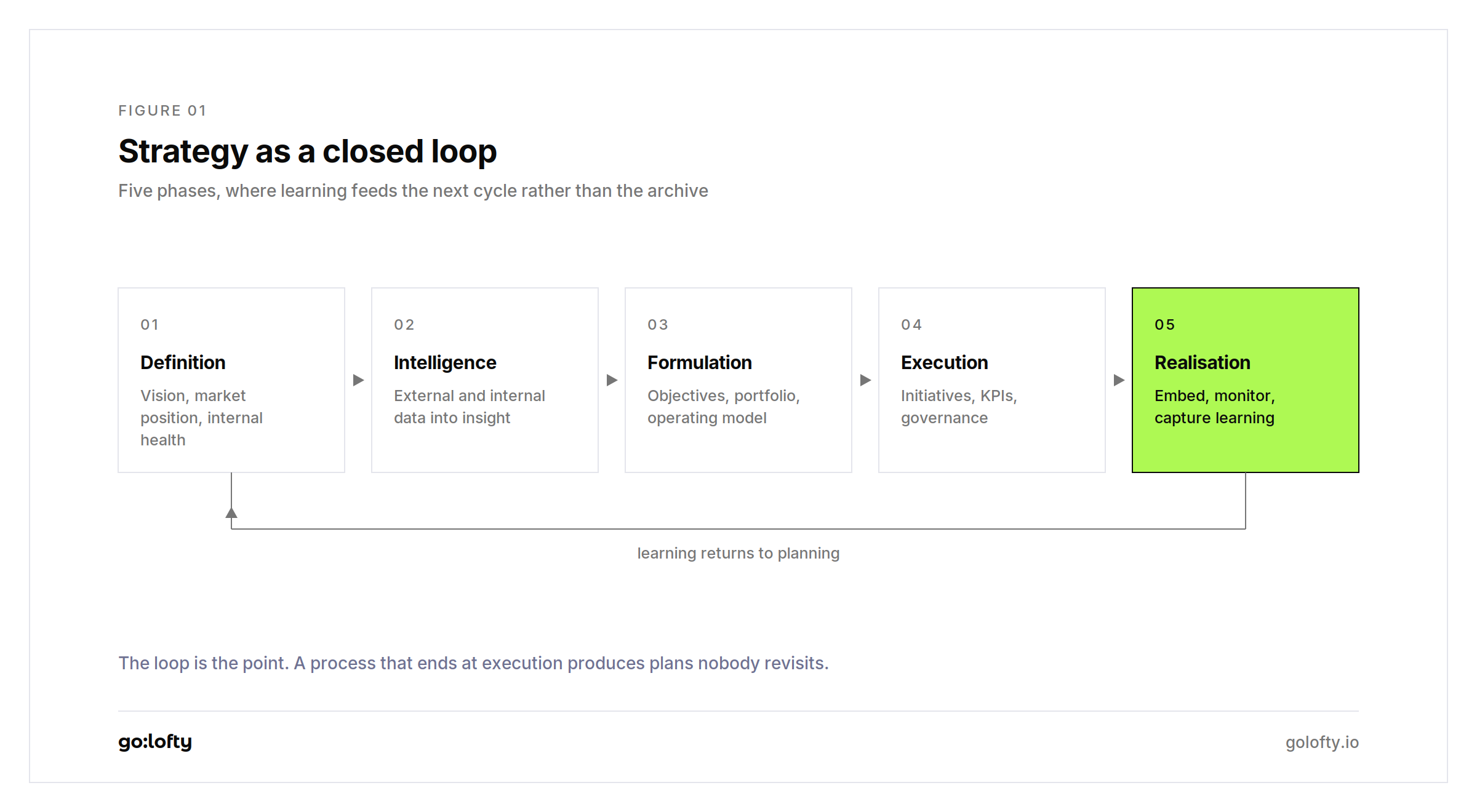
In today's hypercompetitive economy, every business faces the same paradox: strategy has never been more important, and it has never been harder to execute. Disruption arrives every quarter rather than once a decade. Markets shift faster than planning cycles. Technology changes before roadmaps are complete. In that reality, strategy cannot be a presentation deck or an annual offsite. It has to be a living system.
At go:lofty we call that system the Business Strategy End-to-End Process: a structured, continuous loop that integrates vision, intelligence, formulation, execution and realisation into a single strategic operating model. It helps leaders design strategies that are actionable, measurable and adaptable to constant change.
What an end-to-end strategy process means, and why it matters
A true end-to-end process connects every phase of decision-making, from defining ambition to delivering results. It creates an unbroken line between a company's purpose, its market positioning, its operating model and its performance outcomes.
Without that integration, organisations suffer strategy fragmentation: strong plans on paper that never translate into execution, conflicting departmental priorities, and initiatives that stall once the initial enthusiasm fades.
An end-to-end approach ensures that:
- every strategic initiative is tied to measurable objectives;
- market intelligence informs each decision;
- operational systems and teams are aligned behind common goals;
- progress is continuously tracked, learned from and adapted.
It turns strategy from an annual exercise into a core business function, the engine that drives sustainable growth.
Phase 1: strategy definition and analysis
Every journey begins with diagnosis. The first phase lays the foundation for all subsequent choices, because without an understanding of the market, the competition and internal capability, strategy becomes guesswork.
Define the company vision. Not a slogan but a practical north star that states where the organisation intends to be in five to ten years and why. Vision sets ambition and gives direction to every strategic decision that follows.
Conduct competitive analysis. Benchmark against direct and indirect competitors to uncover white space and risk. Examine market share trends, innovation investment, brand perception and pricing dynamics. The point is to see not only where competitors are, but where they are heading.
Perform a company health check. This internal assessment measures current performance, capability maturity, leadership alignment and resource capacity. Clarifying strengths and vulnerabilities lets leaders separate what needs transformation from what needs optimisation.
Outcome: executives hold a complete view of market position, internal health and the external forces shaping the future.
Phase 2: corporate intelligence and market insight
Strategy built on intuition alone is obsolete. Modern strategy relies on continuous market scanning, competitive benchmarking and foresight into emerging trends.
Market analysis. Go beyond static market size. Evaluate trajectories: customer expectations, digital behaviour, regulatory change, technology adoption curves. Identify where growth pockets are emerging and where disruption could occur.
Corporate intelligence. Gather insight on competitor movements, investment patterns, acquisitions and partnership ecosystems. Combine it with macroeconomic and geopolitical analysis to locate strategic risk and opportunity.
Opportunity identification. Convert insight into hypotheses. Which markets should we enter? Which capabilities should we strengthen? Where can we gain first-mover advantage? The best strategies begin as questions rather than as answers.
Outcome: market data becomes actionable intelligence, and leaders can be confident their choices rest on evidence rather than instinct.
Phase 3: strategy formulation
With clarity of context comes choice. Formulation is where insight converts into objectives, portfolios and operational blueprints.
Set corporate objectives. Define specific, measurable, achievable, relevant and time-bound goals aligned to the vision. Objectives should cascade across functions, linking leadership ambition to departmental accountability.
Integrate customer insight. Whether B2B or B2C, customer understanding is the compass. Segmentation analysis, buyer journey mapping and unmet-need assessment keep the strategy anchored in real demand.
Shape the portfolio and offering. Rationalise existing products and services and identify innovation opportunities. Formulation usually involves difficult trade-offs, including discontinuing underperforming segments to concentrate on those that drive future value.
Design the operating model. Define how the organisation will deliver: structure, governance, process design, technology enablers, talent requirements. The operating model is where strategy meets execution.
Align brand strategy. The brand is how the strategy shows up in the market. Messaging, positioning and customer experience should all reflect strategic intent.
Outcome: a coherent roadmap with clear objectives, prioritised initiatives, aligned capabilities and a brand that communicates the intent.
Phase 4: strategy execution
Even strong strategies fail without disciplined execution. This is where organisations most often falter, not because the strategy is wrong but because it was never operationalised.
Define strategic KPIs. Translate objectives into measurable indicators covering both lagging results and leading activity: revenue growth, customer retention, Net Promoter Score, innovation velocity, digital adoption.
Launch strategic initiatives. Break the roadmap into actionable projects with clear ownership, timelines and deliverables. Each initiative should state not only what will be done but how success will be verified.
Build a business case for each initiative. Every major initiative needs an investment rationale covering financial implications, resource requirements, risk factors and expected return. Business cases enforce disciplined prioritisation.
Establish governance. A strategy execution office, or its equivalent, oversees delivery, tracks progress and maintains alignment across teams, creating visibility and accountability at every level.
Outcome: plans become performance, with synchronised objectives, clear accountability and real-time tracking.
Phase 5: strategy realisation
The final phase closes the loop between planning and results. It ensures strategies not only launch successfully but continue to deliver value.
Implement and integrate. Execution must move from project mode into business as usual. New systems, processes and behaviours are embedded into operations, because success depends on embedding change rather than announcing it.
Monitor and adapt. The market never stops moving. Dashboards and feedback loops evaluate performance, and strategy is adjusted quarterly or monthly as conditions change.
Institutionalise learning. Every strategy produces insight about what worked, what did not and what needs refinement. Capturing those lessons feeds the next cycle.
Outcome: the organisation becomes dynamic and self-correcting, and growth is sustainable because learning and execution reinforce each other.
Why companies should establish Strategy as a Function
Most organisations have a strategy. Few have a strategy function: a dedicated capability for continuous planning, execution and adaptation. Treating strategy as a function institutionalises the discipline.
Continuity and alignment. Strategy becomes a living process rather than a one-time event, and the function maintains the link between long-term vision and daily operations.
Agility and decision-making. In fast-moving markets agility is an advantage. A strategy function enables real-time decisions by continuously analysing performance data and market intelligence.
Cross-functional collaboration. When strategy sits at the centre, departments collaborate around shared outcomes instead of competing priorities. Sales, marketing, operations and people functions move in step.
Performance monitoring. A dedicated team tracks KPIs, diagnoses performance issues early and recommends corrective action, creating a feedback-rich environment.
Sustainable growth. Embedding strategy into the organisation's DNA ensures that every initiative contributes to long-term value rather than short-term wins. Organisations that maintain a strategy function tend to see better returns on transformation programmes and greater resilience in a crisis.
What the process changes in practice
- Stronger market positioning. Clear direction and consistent brand communication improve competitiveness.
- Higher operational efficiency. Alignment between strategy and execution removes redundant effort.
- Faster adaptation. Continuous feedback lets leaders pivot without derailing momentum.
- Better returns on initiatives. Projects are prioritised on business case value rather than internal politics.
- Cultural alignment. People understand how their roles contribute to strategic success, which raises engagement and accountability.
Strategy is a capability, not an event
Sustainable growth does not come from a single breakthrough idea or a well-written plan. It comes from a repeatable, disciplined process that connects insight to action and learning to adaptation.
The Business Strategy End-to-End Process is a mindset shift as much as a framework. It turns strategy into a continuous function: measurable, agile and embedded across the organisation.
At go:lofty we help leaders design, operationalise and sustain strategies that accelerate growth and resilience, whether the task is defining the next corporate vision, entering a new market or transforming operations.