The Role of Facilitation in Change Management: A Strategic Blueprint

Change has become the defining condition of modern business. Between digital disruption, economic volatility, geopolitical shifts and sustainability pressure, organisations are navigating constant turbulence. Managing and facilitating change effectively is no longer optional; it is a strategic capability.
Yet despite decades of research and frameworks, most change initiatives still fall short of their intended outcomes. The reasons are depressingly familiar: weak alignment, inadequate leadership sponsorship, stakeholder resistance, poor communication, or a failure to embed new ways of working into the culture.
The challenge is not only what changes but how the change is facilitated. Facilitation provides the structure, discipline and engagement that convert aspiration into sustainable outcomes. It is the connective tissue between the strategic intent of the boardroom and the daily reality of frontline teams.
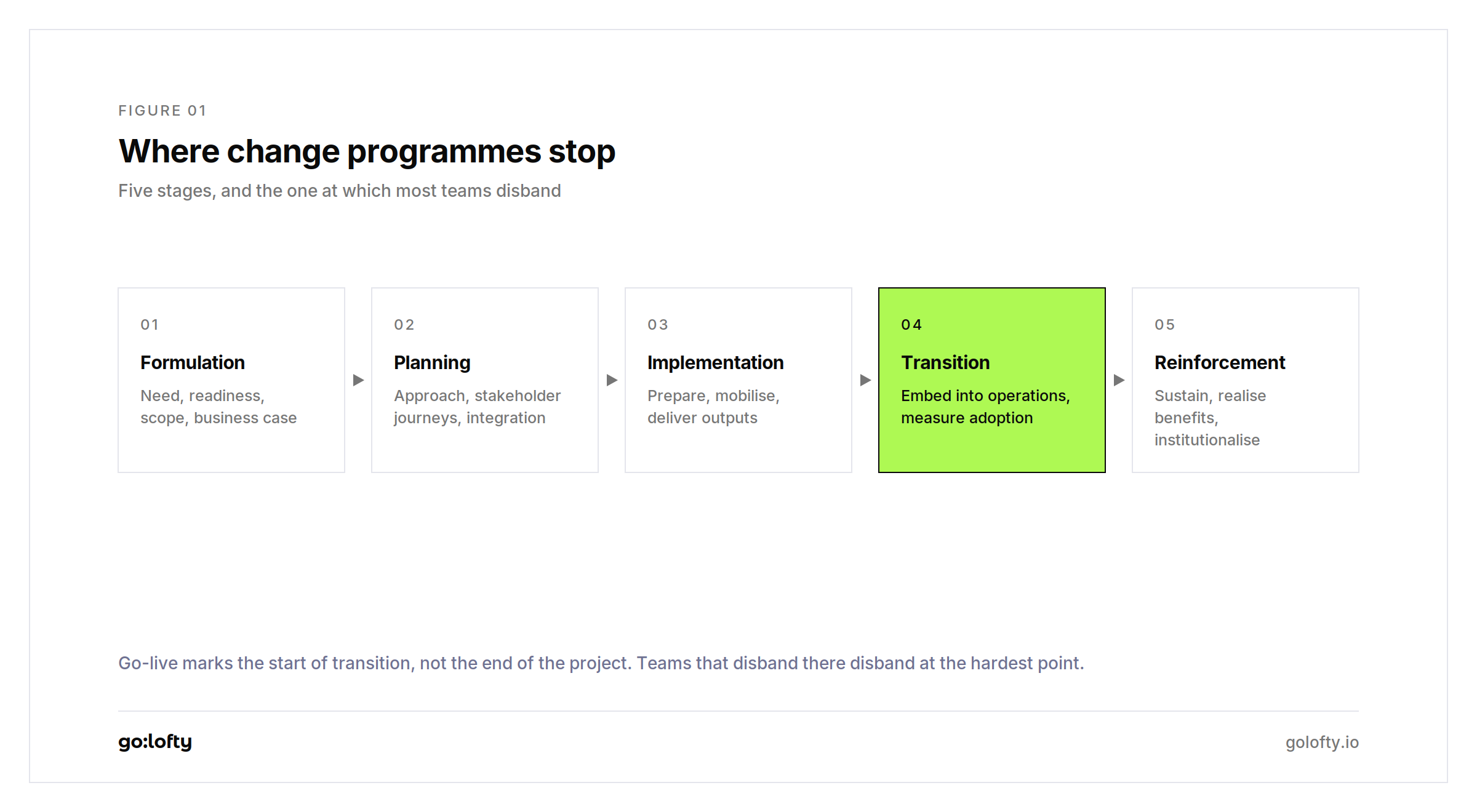
What follows is a facilitation blueprint for change management: an end-to-end approach covering formulation, planning, implementation, transition and reinforcement.
Start with change formulation
Every successful initiative begins with clarity. Without it, organisations plunge into execution without understanding the why, the what or the how. Formulation lays the foundation by articulating the case for change, assessing readiness and defining scope.
Why it matters. Leaders routinely underestimate the power of narrative. People need to know not only what is changing but why now and why it matters. Clear formulation prevents cynicism and confusion, and aligns executive stakeholders around a shared intent.
What it requires.
- Identify the need. Triggers may be external, such as new regulation, market shifts or emerging technology, or internal, such as inefficiency, leadership transition or an innovation opportunity. The first step is recognising and naming the need.
- Assess readiness. Organisations differ in appetite and capacity for change. Gauge cultural resilience, stakeholder openness and resource availability. Imposing transformation on an unprepared organisation guarantees resistance.
- Define scope. Change without boundaries overwhelms. Clarify whether the change touches processes, technology, structures or culture, and to what extent.
- Build the business case. This is the most decisive step. Executives and boards expect numbers rather than slogans. The case must quantify expected benefits, outline risks and demonstrate return. Without it, sponsorship is weak and funding uncertain.
Example. A global pharmaceutical company facing rising compliance costs identified the need to overhaul its regulatory systems. A readiness assessment revealed a culture that was highly process-driven but resistant to digital adoption. Scope was defined narrowly as compliance processes and reporting rather than the whole enterprise. The business case projected a twenty per cent reduction in compliance costs. That clarity secured board approval and set realistic expectations.
Key lesson. Rush formulation and change becomes a slogan. Get it right and you have the foundation for momentum.
Planning turns vision into execution
Once need and scope are defined, planning converts aspiration into a route. Organisations too often move straight from vision to action without designing the journey, which produces misalignment and chaos.
Why it matters. Planning is not about producing thick binders of Gantt charts. It is about making deliberate choices on approach, stakeholder engagement and integration.
What it requires.
- Define the approach. Whether Kotter's eight steps, ADKAR, an agile transformation model or a hybrid, the methodology has to fit the organisation's culture.
- Map stakeholder journeys. Not all stakeholders are equal. Identify champions, influencers and likely resistors, and create tailored engagement plans in which communication runs both ways.
- Plan integration. Timelines, resourcing and risk management must be explicit. Anticipate friction points and design mitigation in advance.
Example. A software company introducing analytics to its sales force built a stakeholder plan that involved sales leaders as early co-creators. Their concerns about job displacement were addressed directly rather than deflected. Adoption exceeded eighty per cent within three months.
Key lesson. Planning is where change becomes predictable. Without it, execution becomes firefighting.
What makes implementation work
Implementation is the visible face of change and where credibility is won or lost. Despite careful planning, many initiatives stall here through poor facilitation.
Why it matters. Implementation is not deploying a system or announcing a policy. It is creating tangible business effects that validate the business case.
What it requires.
- Prepare the organisation. Training, and also psychological preparation. People must understand roles, expectations and benefits.
- Mobilise stakeholders. Empower change champions who advocate within their own teams. Peer influence is usually more persuasive than a leadership mandate.
- Deliver outputs and outcomes. Projects are judged on results rather than activity. The promised outputs, whether processes, systems or structures, have to translate into measurable performance.
Example. A European bank implementing digital know-your-customer procedures prepared staff with simulations and scenario-based training, and mobilised branch managers as champions. Customer onboarding time fell by forty per cent, demonstrating immediate value.
Key lesson. Implementation is not the end. It is the first proof point.
Why transition management matters after go-live
Organisations often declare victory at go-live and then watch adoption lag. Transition management ensures change embeds into daily operations rather than fading.
Why it matters. If people revert to old habits, the change collapses. Sustained facilitation prevents backsliding.
What it requires.
- Embed outputs into operations. Make the new processes business as usual.
- Measure adoption. Track real behaviour change rather than system rollout.
- Adjust for deviations. No plan survives contact with reality. Address obstacles and refine as you go.
Example. A telecoms company rolling out a new CRM faced early adoption problems. Usage dashboards identified the underperforming teams, targeted retraining followed, and the interface was improved. Adoption reached ninety-five per cent within six months.
Key lesson. Transition is where change is won or lost. Measurement and adjustment turn temporary shifts into permanent ones.
Making change stick
The final stage is reinforcement: ensuring the change matures into culture and keeps delivering.
Why it matters. Benefits erode over time. Without reinforcement, organisations slide back into old patterns.
What it requires.
- Ongoing communication. Keep telling the story: why it matters, how it connects to strategy, what it does for people.
- Sense-making. Periodic reflection produces learning. What worked, what did not, and what that means for next time.
- Benefit realisation. The ultimate measure is whether the promised value materialised, which requires tracking KPIs over the long term and holding someone accountable for them.
Example. A pharmaceutical firm institutionalised change audits six months after every transformation. The reviews measured benefits realised, identified gaps and documented lessons. Over time the practice normalised continuous change rather than making it something to resist.
Key lesson. Reinforcement turns change from an event into a capability.
A note on the failure statistics
Change management literature leans heavily on the claim that seventy per cent of transformations fail. The figure is repeated so often that it has acquired the status of fact, and its empirical basis is thinner than its popularity suggests: researchers tracing it back have found the original source difficult to identify and the underlying evidence weak.
That does not mean transformations succeed easily. It does mean that a leadership team should be sceptical of any programme sold on the strength of a headline percentage, including this one. The reasons initiatives underperform are specific and diagnosable, and they are more useful to examine than an aggregate failure rate.
What the blueprint delivers
- Financial performance. Initiatives deliver a return because they are tied to business cases and measured outcomes.
- Organisational alignment. Cross-functional stakeholders stay engaged throughout rather than at the launch only.
- Adaptability. Lessons are institutionalised, which improves the handling of the next change.
- Employee engagement. Transparent communication and genuine involvement reduce resistance and build trust.
Change as a strategic capability
Change is no longer episodic. Companies that treat it as a project risk fatigue and failure. Companies that treat it as a capability gain resilience, adaptability and advantage.
The facilitation blueprint provides a structured way to turn aspiration into execution, execution into adoption, and adoption into sustained value. Facilitation is a hard strategic discipline rather than a soft skill.
At go:lofty we help leaders design and facilitate change so that every transformation delivers measurable impact.