Go-To-Market Strategies: Which Approach Is Right for You?

Go-to-market discussions tend to open with a menu. Product-led or sales-led, and then a longer list: marketing-led, community-led, partner-led, network-led, data-led, founder-led. Each is presented as an option with its own advantages, and the reader is invited to choose the one that fits.
The menu is the problem. Most of those items are not alternatives to one another, and choosing between them is not the decision that needs making. Go-to-market is settled by economics: what a customer is worth determines what you can afford to spend acquiring one, and that determines how the purchase can happen. Everything else follows.
Motions and channels are different things
The single distinction that clears most of the confusion.
A motion is how a purchase actually happens. There are only a few. Self-serve, where the buyer signs up and pays without speaking to anyone. Product-led sales, where they start alone and a salesperson enters when usage justifies it. Inside sales, where a remote team runs a defined process. Field sales, where named people work named accounts over long cycles. Partner, where someone else's organisation carries the transaction.
A channel is where attention comes from. Content, community, developer relations, events, outbound, partnerships, paid acquisition.
Every company runs one or two motions and several channels. Community-led growth is not an alternative to sales-led growth; it is a channel that can feed any motion. Data-led growth is not a motion at all, it is a capability that improves whichever one you run. Founder-led growth is a stage rather than a model, and it describes the period before a motion exists.
A go-to-market plan that names a channel where the motion should be leaves the central question unanswered: how does someone actually buy this.
The four variables that decide
Average contract value. The dominant factor. Acquisition cost has to remain a sensible fraction of what a customer is worth, and each motion carries a different cost.
Time to value. How long before the buyer gets something useful. Self-serve requires this to be minutes to hours, unaided. A product needing configuration, data migration or training cannot be sold self-serve regardless of how good the interface is.
Number of decision makers. One person can self-serve. Two can be managed with good in-product content. Beyond that, someone has to coordinate agreement, and that someone is a salesperson.
Buyer risk. Anything touching regulated data, financial control or operations people depend on brings procurement, security review and legal into the process. That happens irrespective of the product experience, and it makes a purely self-serve motion impossible above a certain contract size.
Preference does not appear on this list. A founder who dislikes hiring salespeople still has to hire them if the product is complex and the contracts are large.
The economics, plainly
Take a salesperson with a fully loaded cost well into six figures once salary, commission, tooling and management are counted. Suppose they close thirty deals a year, which is a reasonable number for a mid-market motion.
That is several thousand pounds of sales cost per deal before any marketing spend. On a contract worth five thousand a year, with normal gross margins, the customer would need to stay for years before the acquisition paid for itself. The motion is not affordable at that price.
The same arithmetic in reverse explains why self-serve fails upmarket. A hundred-thousand-pound contract will not be signed by someone clicking through a checkout page, because the buyer's own process will not permit it, so a motion that offers no human involvement simply loses those deals to competitors who do.
Two measures make this concrete. Payback period, how many months of gross profit are needed to recover the cost of acquiring a customer, where under a year is comfortable and past two years is a problem for anyone not extremely well capitalised. And lifetime value against acquisition cost, useful once retention data exists and misleading before then, because early estimates of lifetime value are usually optimistic.
Which motion at which price
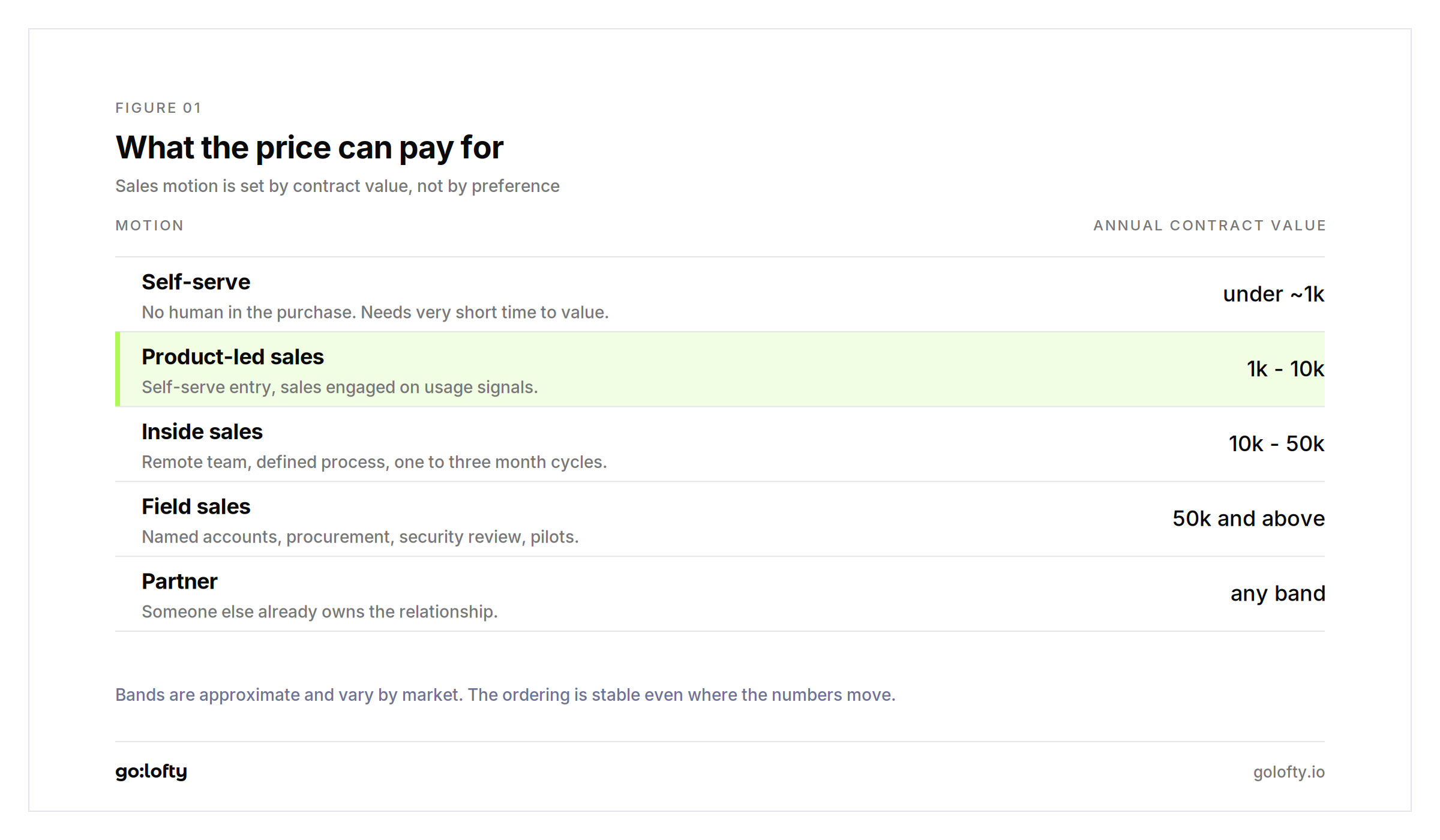
These bands are approximate and vary by market, and the ordering is stable even where the numbers move.
Under roughly a thousand a year: self-serve. No human contact in the purchase. Requires very short time to value, high-volume traffic and a product simple enough to learn alone. Cost sits in product and acquisition rather than in headcount.
Roughly one to ten thousand: product-led sales. Self-serve entry with sales engaged on signals. Efficient at the top of the funnel, human where money enters.
Ten to fifty thousand: inside sales. A remote team running a defined process, demos and trials, cycles of one to three months.
Fifty thousand and above: field sales. Named accounts, longer cycles, procurement, security review, possibly a pilot. Expensive per deal and the only motion that closes deals of this size.
Any band: partner, where someone else already owns the relationship and reaching those customers directly is uneconomic.
Product-led growth is not free
The strongest claim made for product-led growth is that it removes sales cost. It relocates it.
A self-serve motion requires onboarding that works without a human, in-product guidance, usage instrumentation, self-serve billing, and enough traffic to fill a funnel with low conversion. That is engineering, design and marketing investment, and it arrives before revenue rather than alongside it.
It is also harder to reverse. A sales team can be hired in a quarter and reduced in a quarter. A self-serve experience takes six months to a year to build properly and cannot be turned off if it fails to convert.
Product-led growth is the right choice when time to value is genuinely short, the individual user can decide, and the market is large enough to support a low conversion rate. Outside those conditions it produces a beautiful funnel that leaks.
Product-led sales, which is what most companies actually need
The hybrid has become the default for good reason.
The product is free or inexpensive to start. Individuals adopt it without speaking to anyone. Usage within an account is instrumented, and sales engages when the signals justify the cost of a conversation: several users in one organisation, a usage threshold crossed, an administrative or security question raised.
The top of the funnel runs at self-serve efficiency and a person appears at the point where budget, procurement and negotiation enter. The requirement is that the usage data exists, is aggregated by organisation rather than by user, and reaches sales in a usable form. Most failed attempts fail there rather than on the concept.
Running two motions
Established companies run several. Early companies generally cannot.
Each motion needs its own packaging, pricing, staff, measurement and management attention. A team of fifteen split across self-serve and enterprise runs both badly, and the enterprise deals consume the attention because they are larger and louder, while the self-serve motion decays quietly.
Prove one motion first. Proof means it acquires customers at a cost the business can carry, it repeats without a founder in the room, and the numbers hold over two or three quarters. Then add the second.
Moving upmarket
The most common motion change, and the most commonly underestimated.
Selling to larger organisations is not the same activity performed on bigger accounts. The commercial surface has to change: annual contracts instead of monthly, invoicing and purchase orders instead of card payments, a process for answering security questionnaires, in many cases an audit certification, role-based permissions, administrative controls, single sign-on, and a support commitment somebody will hold you to.
None of that is sales work and all of it is required before a serious enterprise deal will close. Companies that hire an enterprise team without building it lose deals during procurement and conclude that the team was the problem.
Signals the motion is wrong
- Payback stretching past what the business can fund. The motion costs more than the price supports.
- Cycles lengthening as deals grow. Procurement has entered a process designed for individuals.
- Sales occupied by small deals. Those customers should be arriving without a person attached.
- Free users who never convert. The free tier is delivering the whole value rather than a sample.
- A founder who cannot hand over the sale. There is founder-led selling, which is not yet a motion.
Choosing, in practice
- Establish the average contract value you are actually achieving, not the one on the pricing page. Discounting tells you what the market will pay.
- Measure time to value honestly, from signup to a genuinely useful result, watching real users rather than estimating.
- Count the people who have to agree in a typical closed deal.
- List what procurement demands at the contract size you are targeting.
- Pick the motion those four answers point to, even where it is not the motion you would prefer.
- Choose channels that feed it. Content and community suit long consideration cycles. Developer relations suits technical buyers. Outbound suits concentrated markets with few named accounts.
- Measure payback quarterly and treat a deteriorating trend as a signal about the motion rather than about effort.
The point
Go-to-market is not a menu of philosophies. It is a question of what the price can pay for, how quickly the product delivers value, how many people have to agree, and what risk the buyer is carrying.
Answer those and the motion is largely determined. Choose channels to feed it. Run one until it works before adding another. And when the motion needs to change, change the commercial surface as well, because hiring different people to run the same machine does not produce a different result.
At go:lofty we design go-to-market as part of the wider growth architecture, starting from the economics rather than from the label.