How to Master Startup Fundraising

Most fundraising advice concentrates on the pitch, which is the part founders can control and the part that matters least. Decks are refined, narratives are polished, and the round still goes quiet, because the difficulty was never the presentation. It was that the evidence did not match what the stage required, or the process was run as a queue, or the term sheet was assessed on its headline number.
This covers the parts that determine outcomes: what each stage actually expects, how the instruments work, which terms matter beyond valuation, and how to run a raise as a process.
What follows is general information rather than investment or legal advice. Terms should be reviewed by a qualified lawyer in the relevant jurisdiction before signing.
What each stage expects
The most common cause of a stalled raise is applying the wrong stage's expectations. Every stage funds a different kind of risk, and the evidence required is correspondingly different.
Pre-seed funds a team and an insight. There is rarely a product and there is no revenue to speak of. What is being underwritten is the founders: whether they understand something about the problem that others do not, and whether they can build. Credibility comes from domain depth, prior work and the specificity of the insight.
Seed funds early evidence that the thing works. A product exists, people use it, and some of them pay. The numbers are small and the direction matters more than the level: retention that holds rather than decays, usage that deepens, a handful of customers who would be annoyed if the product disappeared.
Series A funds a repeatable commercial motion. This is the sharpest step and the one most founders underestimate. It is no longer about whether people want the product but whether the company can sell it predictably: revenue growing on a curve investors recognise, retention that holds at scale, and a sales process that works when someone other than a founder runs it. Series A investors are underwriting a machine rather than a promise.
Being clear about which of these you are raising, and being honest about whether the evidence is there, saves months. A seed-stage business with Series A ambitions in its deck reads as a company that does not know what it is.
How the instruments work
The choice of instrument determines what is being agreed and what is being deferred.
SAFEs defer the valuation question. Money goes in now and converts to equity at the next priced round, typically with a discount, a valuation cap, or both. They are fast, cheap and standard for early rounds. They are not debt: there is no interest and no maturity date, so nothing falls due if the next round is slow.
Convertible notes do the same job as debt. They carry interest and a maturity date, which means that if no priced round arrives before maturity, the position has to be renegotiated from a weaker footing.
Priced rounds settle the valuation immediately and issue shares. Full documentation, a shareholders' agreement, usually a board seat. Slower and more expensive to complete, and unambiguous about what everyone owns.
One trap deserves naming. Successive SAFEs at different caps stack, and they all convert at once. Founders who raise three rounds of SAFEs without modelling the conversion regularly discover at Series A that they own considerably less than they assumed. Model the fully diluted position after conversion before signing each one, not after the third.
The terms that matter more than valuation
Valuation is the number founders discuss and rarely the term that determines the outcome.
Liquidation preference. This sets who is paid first on an exit and how much. One times non-participating is the standard and means the investor takes either their money back or their percentage of the proceeds, whichever is greater. A participating preference means they take their money back and then share the rest. A multiple raises the amount taken first. In a large exit the difference is modest. In a moderate one it can consume most of the founders' proceeds. A higher valuation with a participating two times preference is often a worse deal than a lower valuation on clean terms.
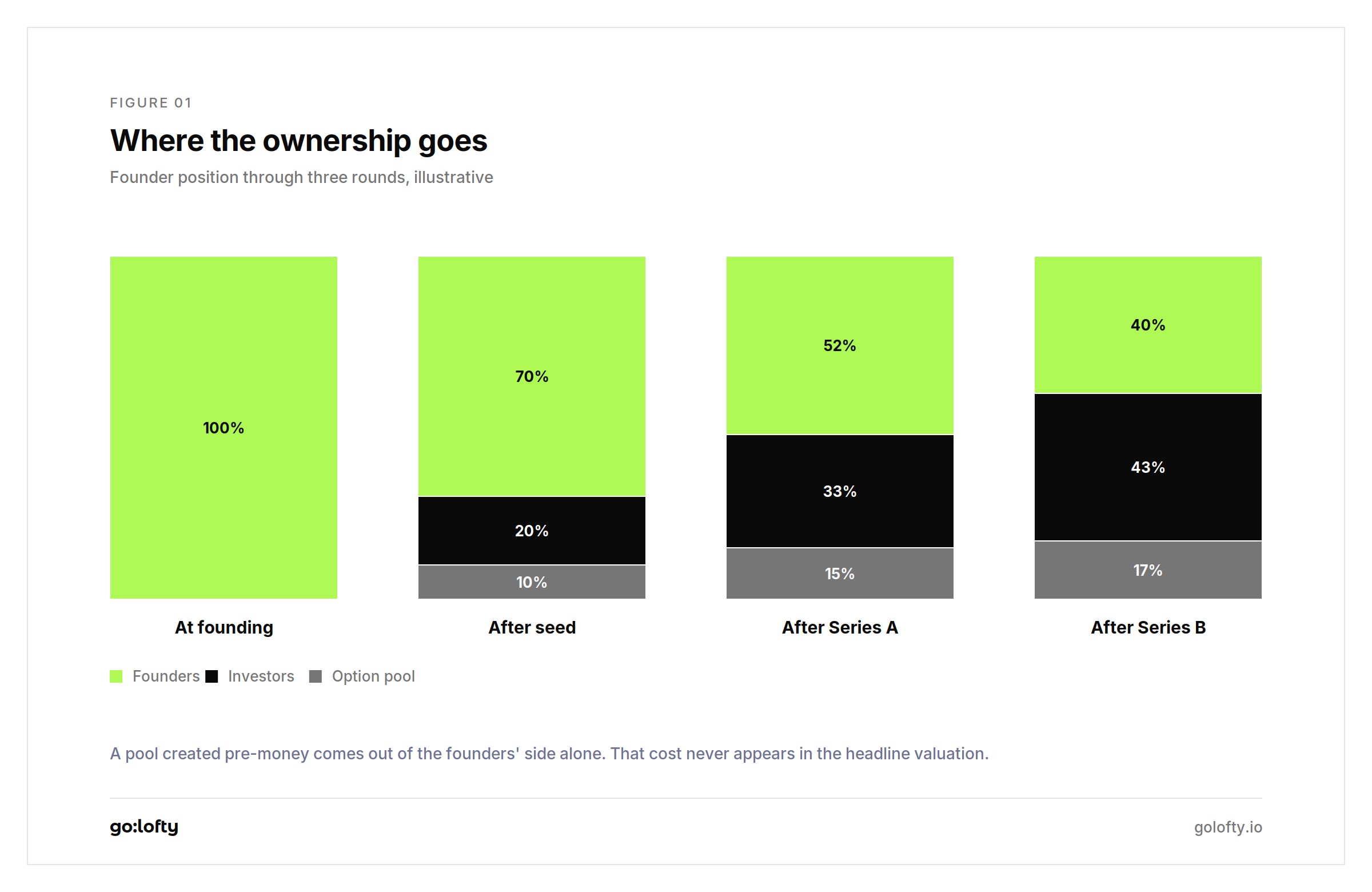
The option pool. Term sheets require a pool for future hires, and where it sits in the calculation decides who pays for it. Created pre-money, it dilutes existing shareholders only, which means the founders. Created post-money, the investor shares the dilution. A ten per cent pre-money pool can quietly cost several points of founder ownership that never appear in the headline number. Negotiate the pool against a genuine hiring plan for the next eighteen months rather than accepting a round percentage.
Board composition. Who sits on the board determines who can remove the chief executive. This is more consequential than any economic term and receives a fraction of the attention.
Protective provisions. The list of decisions requiring investor consent. Reasonable in principle; worth reading closely, because an over-broad list can mean needing permission to hire, to change pricing or to sign a significant contract.
Pro-rata rights. The right to maintain a percentage in later rounds. Standard, and it consumes allocation in future rounds that might otherwise go to a new lead.
Dilution, concretely
Founders consistently underestimate cumulative dilution because each round is assessed on its own.
Take a company where the founders hold everything. A seed round sells twenty per cent, and a ten per cent option pool is created pre-money. The founders now hold roughly seventy per cent rather than eighty, because the pool came out of their side. A Series A sells another twenty per cent and expands the pool by five points, taking the founders to somewhere near fifty-two. A Series B on similar terms puts them around forty.
None of that is unusual and none of it is unfair. The point is that it should be modelled at the first round rather than discovered at the third, because the decisions that shape it, particularly pool sizing and how much is raised, are made early.
Run a process, not a queue
The single largest improvement available to most founders is structural rather than narrative.
A queue means approaching investors one at a time and waiting for each answer. It takes months, generates no urgency, and lets every investor wait to see what others do.
A process means preparing everything first, then opening conversations with the whole list within the same fortnight and holding first meetings in a compressed window. Interest arrives together, which gives everyone a reason to decide and gives the founder real choice between offers.
The cost is that rejection also arrives together, which is unpleasant for a week. The benefit is a raise that closes in months rather than quarters, at better terms, with the founder able to choose the investor rather than accept the only one still talking.
Practically: prepare materials and the data room before any outreach; build a list of forty to sixty genuinely relevant firms rather than a hundred generic ones; prioritise warm introductions, which reliably outperform cold approaches; and expect the whole sequence to take three to six months from first meeting to funds received.
Timing
Start when there are at least nine months of runway. Below that, the raise is conducted from weakness, and investors read it accurately in the questions founders ask and the speed at which they concede.
The stretch between a signed term sheet and money arriving is four to eight weeks of diligence and documentation, and it is routinely left out of the runway calculation.
Capital that is not equity
Grants cost no equity and a great deal of administration. They suit research-intensive work and sectors with public priority behind them: climate, health, defence-adjacent technology. Timelines are long, reporting obligations are real, and the money is restricted to the stated purpose.
Venture debt requires existing revenue and usually a recent equity round. It carries covenants, warrants and interest, and it is genuinely useful for extending runway between rounds. It is dangerous when used to fund a business that has not yet found its model, because the repayment schedule does not care whether the model was found.
Revenue-based financing repays as a share of monthly revenue. Flexible, no equity, and expensive relative to its headline rate when revenue grows quickly, because the total repayment is fixed while the period shortens.
Customer revenue remains the only capital with no cost at all, and the only one that also validates the product.
Rejection, and what to take from it
Most conversations end in no. That is arithmetic rather than judgement: a fund making fifteen investments a year sees several thousand companies.
Separate the polite reasons from the real ones. Too early, not our focus and timing are usually courtesy. The signal worth having is the pattern: the question that keeps arriving across many meetings and that you cannot answer well. When five investors ask the same thing and the answer is thin, that is the work to do before the next set of meetings, and it is worth more than any individual piece of feedback.
When not to raise
When the business would be viable without it and equity would only accelerate something already working.
When the model is not yet understood, because funding an unprofitable unit economic scales the loss rather than fixing it.
When the founders would not accept the growth trajectory equity investors require. That is a legitimate choice, and it is incompatible with venture capital, so the honest response is to build a different kind of company rather than a reluctant version of that one.
When the raise is a way of postponing a decision about the product or the market. The money will not make the decision.
The point
Fundraising is a process with a structure, and the structure decides more than the pitch does. Know which stage you are raising and whether the evidence supports it. Understand the instrument and model the dilution before the third SAFE rather than after. Read the preference, the pool and the board seats before the valuation. Run the raise as a compressed process rather than a queue. Start with runway in hand.
At go:lofty we help founders prepare for capital raises and connect them with specialist financing partners. We do not provide investment advice or arrange transactions.