Navigating Military Needs: How Defence Tech Startups Can Drive Innovation

Most guidance on entering defence technology describes the sector: threat domains, technology categories, the list of stakeholders. It is accurate and it does not help, because the difficulty is not identifying what militaries need. It is that the buying process is unlike any commercial process, and a company built for one will fail at the other.
What follows is how the purchase actually happens, why demonstrations rarely become contracts, and what a small European supplier can realistically pursue.
Who decides
The single most expensive mistake is assuming the enthusiastic operational user can buy something.
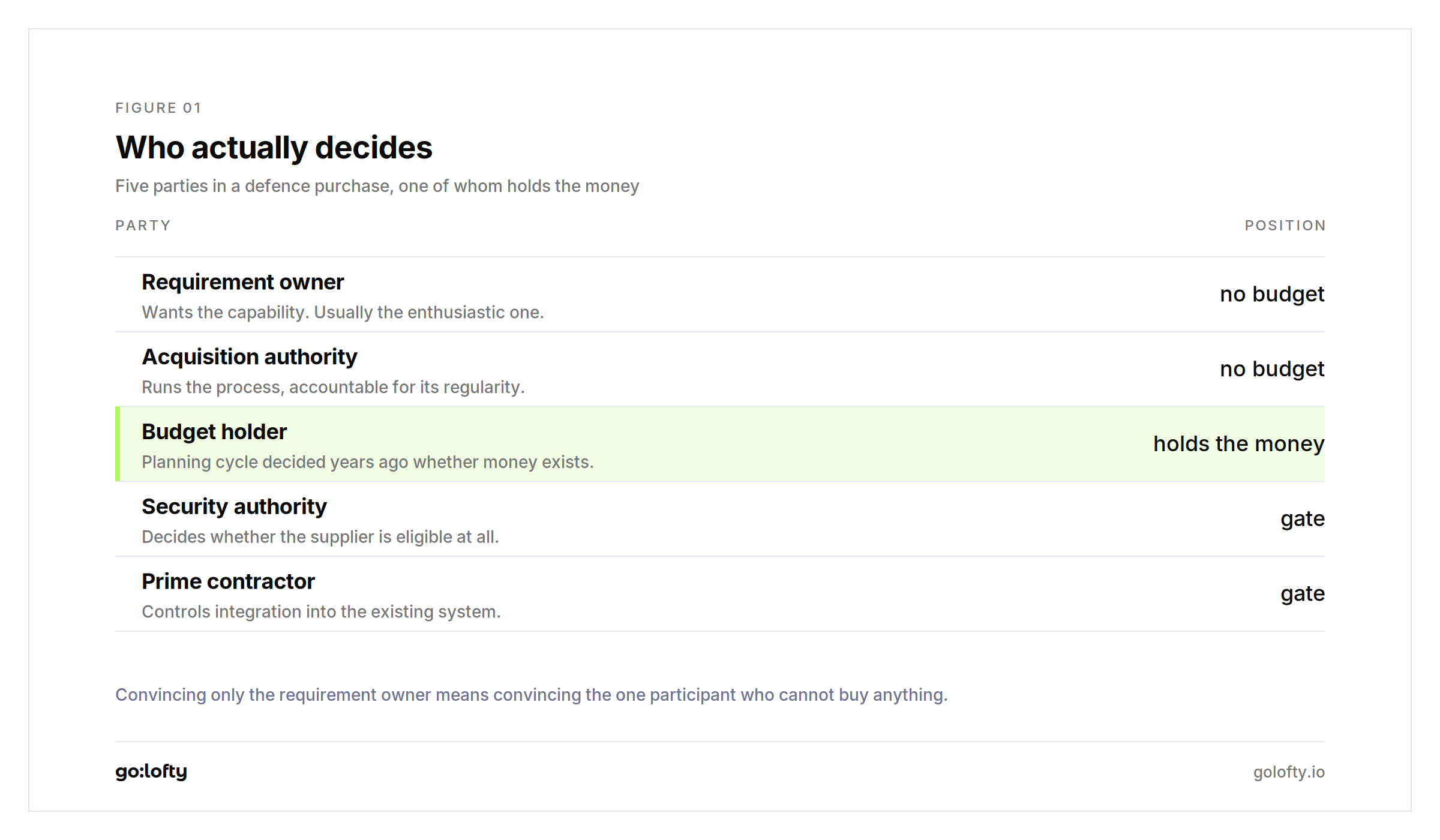
A defence purchase involves at least five parties. The requirement owner in the armed service who wants the capability and is usually genuinely enthusiastic. The acquisition authority who runs the process and is accountable for its regularity. The budget holder, whose planning cycle determined years ago whether money exists in the relevant year. The security authority who decides whether the supplier is eligible to hold the information. And frequently a prime contractor who controls integration into the existing system.
A supplier who has convinced only the first has convinced the one participant with no purchasing authority. That is the origin of the pattern where a startup reports strong interest for eighteen months and no contract.
The valley of death
Innovation funds exist to award pilots, and pilots are comparatively easy to win. Converting one into recurring procurement is a different problem entirely.
A programme of record requires a budget line planned in an earlier cycle, an operational sponsor willing to defend it against competing priorities, and usually a route through an existing prime contract, since the capability has to integrate with something.
None of that is influenced by how well the demonstration performed. Companies collect three or four pilot awards, treat the sequence as traction, and reach the end of their runway with excellent technical references and no recurring revenue.
The practical test to apply before accepting a pilot: which budget line would fund this at scale, in which year, and who owns it. If nobody in the customer organisation can answer, the pilot is a technology demonstration and should be costed as marketing rather than as a sales stage.
European routes to market
Most written guidance in this field is implicitly American. The European landscape is different in structure.
The European Defence Fund co-finances collaborative research and development, generally requiring a consortium spanning several member states rather than a single company. It suits a specialist supplier joining a group, not a startup seeking a customer.
NATO innovation programmes include an accelerator network and a dedicated fund investing in dual-use technology, aimed specifically at bridging the gap described above.
The NATO Support and Procurement Agency handles common procurement on behalf of member states, which offers a route to multiple national customers through one contracting relationship.
National defence innovation bodies. Most member states operate one, with small contract instruments designed for companies that cannot survive a standard procurement timeline.
Subcontracting to a prime. Frequently the fastest route to a first defence reference. Less glamorous than a direct contract, and it supplies revenue, integration experience and a name the next customer recognises.
The legal framework
Defence and sensitive security procurement in the EU falls under Directive 2009/81/EC, which provides more flexibility than ordinary public procurement, including negotiated procedures and specific provisions on security of supply and security of information.
Separately, Article 346 of the Treaty on the Functioning of the European Union permits a member state to set the rules aside where essential security interests are engaged. In practice this means a proportion of defence contracting happens nationally, without open competition, on grounds a supplier cannot contest.
Establish which regime an opportunity sits under before investing in a bid. The effort required and the probability of success differ enormously between the two, and the information is usually available in the notice.
This is a summary rather than legal advice.
Clearance, which gates everything
Classified work requires facility security clearance for the company and personnel clearance for named individuals, granted by a national authority, taking months at best and frequently longer.
Three consequences follow. Clearance cannot be arranged after a bid opens, so a company without it is ineligible rather than uncompetitive. Nationality requirements can restrict which employees may work on a programme, which affects hiring and sometimes ownership. And the timeline should be started well before it is needed, because it is one of the few things in this sector that can be advanced without a customer.
Export control
The EU dual-use regulation covers a wide range of defence-adjacent technology, and the 2021 recast extended attention to cyber-surveillance items in particular. Where US-origin components are involved, the US regimes apply regardless of where the company is established.
The commercial consequences arrive before the compliance ones: classification constrains which customers can be sold to, which suppliers can be used, who can be employed and sometimes who can invest. Establishing the position early is considerably cheaper than discovering it during due diligence.
Cash
Defence contracting is slow at both ends. A year from award to first delivery is unremarkable, milestone payments lag delivery, and public buyers pay against documentation that takes time to produce and approve.
A company financing that gap from equity is using expensive capital as working capital. This is the strongest practical argument for a dual-use product line: commercial revenue while the defence sale takes its course. Dual-use does not shorten procurement or exempt anyone from export control, and it does determine whether the company is still trading when the contract arrives.
Intellectual property
Three questions, settled in the contract rather than afterwards.
Who owns the results of publicly funded development. What licence the buyer receives. And whether that licence permits the buyer to have the design manufactured by somebody else.
Government use rights are common and frequently reasonable. Terms allowing transfer of the design to another supplier are also encountered, and they determine whether the company has built a product or performed development work for hire. Read them before signing, because they are close to impossible to renegotiate later.
What is realistically open to a new entrant
Software and data. The barrier is accreditation rather than manufacturing capital, which is a barrier a small company can actually clear.
Secure communications and infrastructure resilience. Commercial and defence requirements overlap heavily, which makes dual-use genuine rather than nominal.
Training and simulation. Ordinary software economics, lower classification burden, recurring budgets.
Sensing and components supplied into prime programmes, where the qualification burden is real and bounded.
Sustainment and logistics software. Unglamorous, persistently underserved, and budgeted every year rather than programme by programme.
What is not realistically open from a standing start is anything requiring platform-scale capital or deep national classification. Those markets are held by primes and national laboratories for structural reasons: the capital requirements, the classification barriers and the integration relationships are all beyond what a new company can assemble. Guidance that lists them as opportunities for startups is describing a technology roadmap rather than a market.
Working with primes rather than around them
The sector is prime-dominated: large integrators hold the customer relationships, the programme contracts and the systems knowledge.
That is not necessarily a disadvantage. A subcontract provides revenue, a defence reference and integration experience, all of which are hard to obtain otherwise.
It becomes a problem where the prime holds the customer relationship entirely and the supplier has no independent route to a contract. Plan against that from the start: keep a direct relationship with the end user where the contract permits it, and avoid a position where a single integrator can decide the company's future.
A realistic sequence
- Identify the budget line, not the requirement. Requirements are plentiful and budgets are not.
- Begin clearance early if classified work is intended.
- Establish the export control position before it constrains a decision already taken.
- Build the commercial revenue line that funds the company through the procurement cycle.
- Take a subcontract to obtain the first reference, unless a direct route is genuinely available.
- Test every pilot against the question of which budget would scale it.
- Read the IP terms before the first publicly funded contract, not the third.
The point
The defence market is not difficult because requirements are hard to identify. It is difficult because the buying process is slow, the decision is distributed, eligibility is gated by clearance and export control, and a successful demonstration carries no obligation on anyone to purchase anything.
A company that plans around the budget cycle rather than the requirement, funds itself commercially through the gap, and settles clearance and IP before they become urgent has removed most of the reasons companies fail here.