How to Master People Change Management

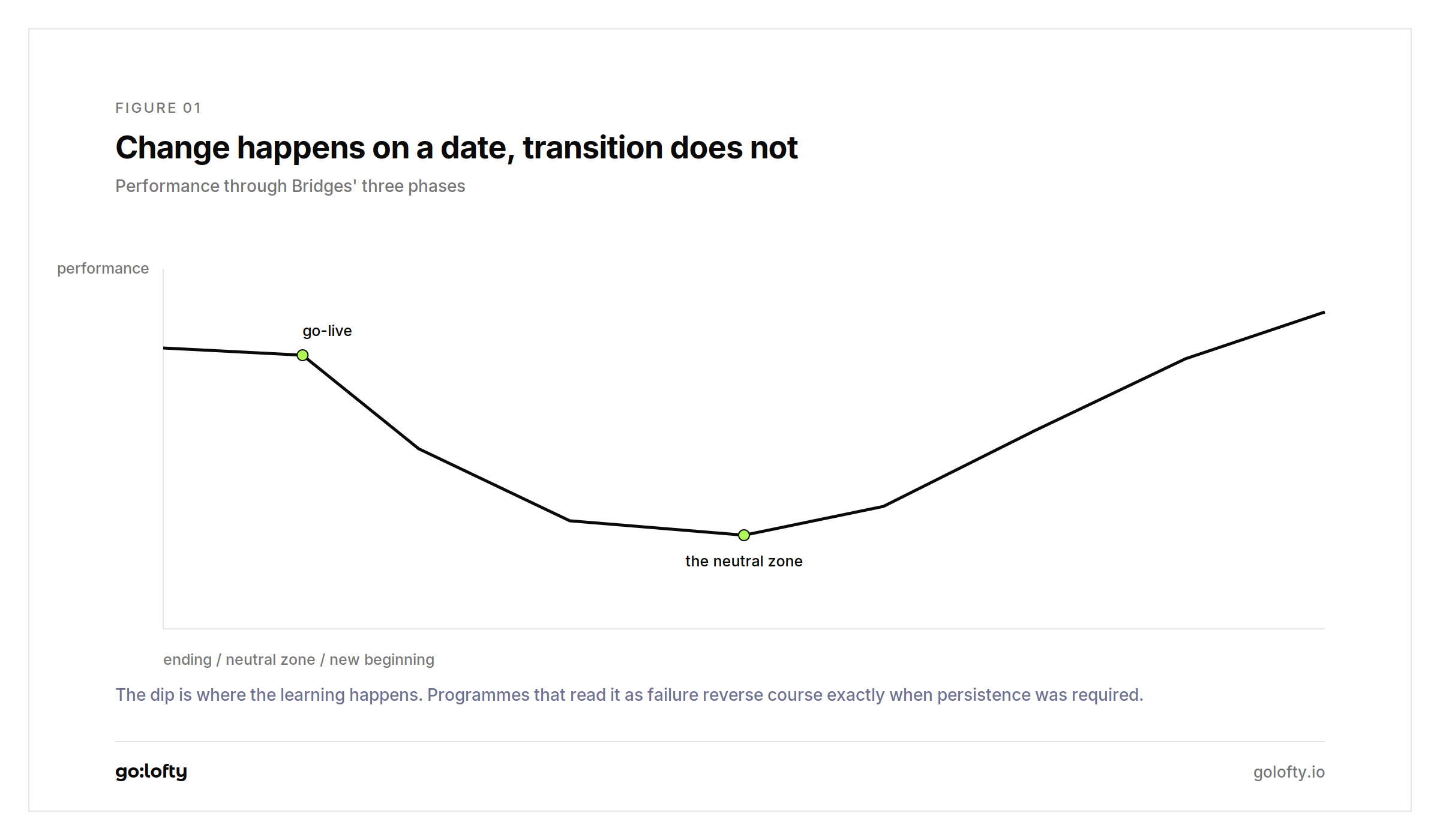
Most change programmes are planned as if the difficulty were logistical. A date is chosen, a system is configured, training is scheduled, an announcement goes out. Then adoption comes in at forty per cent, workarounds appear, and the programme team concludes that people resisted.
People rarely resist change as such. They respond to specific things the change takes away from them, on a timetable that has nothing to do with the go-live date. Managing that is a different discipline from managing the rollout, and it is the one most organisations under-resource.
Change and transition are not the same thing
The distinction comes from William Bridges and it is the most useful idea in this field.
Change is external and situational. The new system goes live on the fourteenth. The teams merge at the end of the quarter. The policy takes effect on Monday. Change happens on a date and can be project-managed.
Transition is internal and psychological. It is the process a person goes through in coming to terms with the change, and it runs on its own schedule. Bridges described three phases.
The ending. Before anyone can take up a new way of working, they have to let go of the old one, which usually means letting go of something they were good at. This phase is characterised by loss, and it is routinely mistaken for negativity.
The neutral zone. The old arrangement is gone and the new one is not yet natural. Productivity dips, anxiety rises, and people improvise. This is uncomfortable and it is also where most of the genuine learning happens. Programmes that treat the dip as a failure signal often panic and reverse course exactly when persistence was required.
The new beginning. The new way becomes normal and stops being a subject of conversation. This arrives later than the plan assumes, and it arrives at different times for different people.
The practical consequence is that the go-live date marks the start of transition rather than the end of the project. A programme that disbands at go-live disbands at the moment its work becomes hardest.
Resistance is a symptom, and it has a specific cause
Treating resistance as an attitude problem produces communication campaigns that address the wrong thing. Resistance is a response to loss, and the losses are identifiable.
- Loss of competence. Someone who was the acknowledged expert in the old system becomes a beginner. For an experienced person this is genuinely humiliating, and it is the most common source of quiet obstruction.
- Loss of relationships. Reorganisations break working partnerships that took years to build and that often carried more of the real coordination than the org chart did.
- Loss of status. A role that used to sign things off now recommends. Nobody says this out loud; everybody notices it.
- Loss of territory. Budget, headcount or decision rights move elsewhere.
- Loss of certainty. Not knowing whether your role survives is a different problem from disagreeing with the change, and no amount of vision will address it.
Naming the losses explicitly does more to reduce resistance than explaining the benefits again. People can accept a loss that has been acknowledged. They cannot accept one that is being denied while they are asked to be enthusiastic.
Diagnosing a stalled adoption
When adoption is poor, the useful question is not why people are resisting but which condition is missing. Prosci's ADKAR model sets out five conditions that have to hold, in order, for one person to change how they work.
Awareness of why the change is needed. Desire to participate. Knowledge of how to do the new thing. Ability to do it in practice, which is not the same as knowing. Reinforcement to prevent reversion.
The value is diagnostic, because each gap has a different remedy and applying the wrong one wastes the effort entirely.
- An awareness gap is a communication problem, and it is the only one communication fixes.
- A desire gap belongs to the sponsor and the line manager. More emails will not touch it.
- A knowledge gap needs training.
- An ability gap needs practice, coaching and time, and it is regularly misdiagnosed as a knowledge gap. Sending someone on the course again does nothing when they attended, understood, and still cannot do it under real conditions.
- A reinforcement gap shows up as adoption that decays after three months.
Sequence matters. Training people who have no desire to change produces attendance without adoption, and the training budget is spent proving it.
Sponsorship outranks everything else
Across the research on change effectiveness, one factor consistently separates programmes that land from those that do not: active and visible sponsorship by the senior leader who owns the change.
Active and visible has a specific meaning, and it is not a launch email.
- Communicating repeatedly and personally. Not once, and not delegated to communications. The message needs to come from the person whose decision it was, in their own words, more times than feels necessary.
- Being seen to use it. If the executive team continues to ask for the report in the old format, everyone knows which system actually matters.
- Building a coalition. Peer sponsors in the other functions, so the change is not seen as one department's initiative.
- Removing obstacles. Especially where the change collides with an existing incentive. If a manager's bonus depends on a metric the new way of working temporarily depresses, no communication will resolve that. Only the sponsor can.
The most common failure is the sponsor who delegates sponsorship. A programme manager can run the programme; they cannot be the sponsor, because they lack the authority that makes sponsorship mean anything.
Middle managers are the layer that decides
When someone wants to know what a change means for them, they ask their own manager, not the executive who announced it. Whatever that manager says overrides the official message, whether or not the manager is well informed.
Middle managers are also asked to absorb the change while continuing to deliver their existing targets, usually without any adjustment to those targets. That makes them simultaneously the most important group in a change programme and the most frequently neglected one.
What they need is specific: to hear about the change before their teams do; answers to the questions they will actually be asked, including the uncomfortable ones about jobs; explicit permission for the productivity dip; and a realistic allowance of time for the coaching they are being asked to do.
Change saturation
An organisation has a finite capacity to absorb change, and past that point additional initiatives degrade all of them rather than adding to the total.
The signals are recognisable: initiative fatigue, cynicism that predates any specific programme, high-performing people declining to get involved, and a pattern of changes that are announced and then quietly abandoned. Each abandoned programme teaches the organisation that waiting out the next one is a viable strategy.
Managing saturation requires a portfolio view: a single register of every change landing on each population, with someone empowered to sequence and postpone. Most organisations do not have one, which is why the tenth initiative of the year meets resentment rather than resistance, and why it is nobody's fault in particular.
What to measure
Activity metrics are the default and they measure the wrong thing. Sessions delivered, emails opened and intranet visits describe the programme's effort rather than its result.
The measures that matter are:
- Adoption. What proportion of the target group is using the new way of working.
- Proficiency. Whether they are using it correctly, which is a separate question and usually a worse number.
- Utilisation. How much of the intended capability is actually being used, as distinct from the minimum needed to get through the day.
- Speed of adoption. How long to reach a stable state, which is the number that most directly determines whether the business case holds.
Alongside these, short pulse surveys asking two questions, how clear the change is and how confident the person feels, will surface problems weeks before the adoption numbers move.
Involvement, honestly done
Involving people in shaping the change improves both the design and the adoption, and it only works when the involvement is real.
Be explicit about which decisions are open and which are already made. That the company is moving to a new platform may not be negotiable; how the workflow is configured, what the training looks like and what the sequence of rollout is may be entirely open. Saying so plainly is better received than a consultation that pretends everything is on the table.
Consultation that cannot change anything is worse than no consultation. People recognise it quickly, and the conclusion they draw is that the whole process is theatre, which then applies to the parts that were sincere.
Champions, and why they usually fail
A champion network extends a small programme team into places it cannot reach, and peer influence carries further than a mandate. Two failure modes account for most disappointing champion programmes.
Appointment rather than selection. Champions chosen by managers tend to be the enthusiastic and the available. Champions chosen for credibility are the people others actually ask, who are not always the same people and are frequently busier.
No time. A champion with a title and no allocated hours will do the day job, because that is what they are measured on. Championing needs real capacity, and if the organisation will not fund the hours it does not have a champion network.
The order that works
- Confirm sponsorship before anything else. If the senior leader will not commit visible time, the honest move is to say so rather than to proceed and blame adoption later.
- Identify who is affected and how, group by group. A change that is trivial for one function may remove another function's reason to exist.
- Name the losses for each group, and decide what is being offered in exchange.
- Prepare the managers before the announcement, with the difficult answers included.
- Announce, from the sponsor, with the reasoning and the cost stated honestly.
- Build knowledge and then ability, which means practice under real conditions rather than a session in a room.
- Measure adoption and proficiency from week one and act on what they show.
- Reinforce past the point where it feels necessary, because reversion happens in month three, not month one.
External support and its limit
Outside help earns its cost where the capability does not exist internally, where independence matters because internal positions are entrenched, or where leaders need coaching for conversations they have not had before.
Its limit is worth stating plainly: an external party cannot supply sponsorship. A consultant can design the programme, prepare the managers, build the measurement and coach the executive, and if the leader who owns the change is not visibly behind it, none of that changes the outcome.
The point
The people side of change is not the soft complement to the real work. It is where the return on the investment is either realised or lost, because a system nobody uses properly returns nothing regardless of how well it was implemented.
Distinguish change from transition. Treat resistance as information about a specific loss. Diagnose stalled adoption rather than exhorting harder. Insist on visible sponsorship, prepare the managers first, respect the organisation's capacity, and measure adoption rather than activity.
At go:lofty we design and run the people side of change as part of the wider operating model work, on the principle that adoption is a design problem rather than a communication one.
Talk to us about a change your organisation actually has capacity for.