Understanding the Strategy Pyramid: A Comprehensive View of Strategy Levels and Execution

In today's volatile business environment, strategy is no longer an annual presentation. It is a daily operating discipline. Organizations that thrive treat strategy as a multi-layered system that connects long-term vision with day-to-day execution.
The Strategy Pyramid and the Purpose-Strategy-Execution Pyramid are two frameworks that bring structure to this system. Together they provide leaders with a blueprint for strategic alignment, ensuring that corporate goals cascade clearly through business units, functions and teams, driving synchronized execution across the enterprise.
What is the Strategy Pyramid and why does it matter?
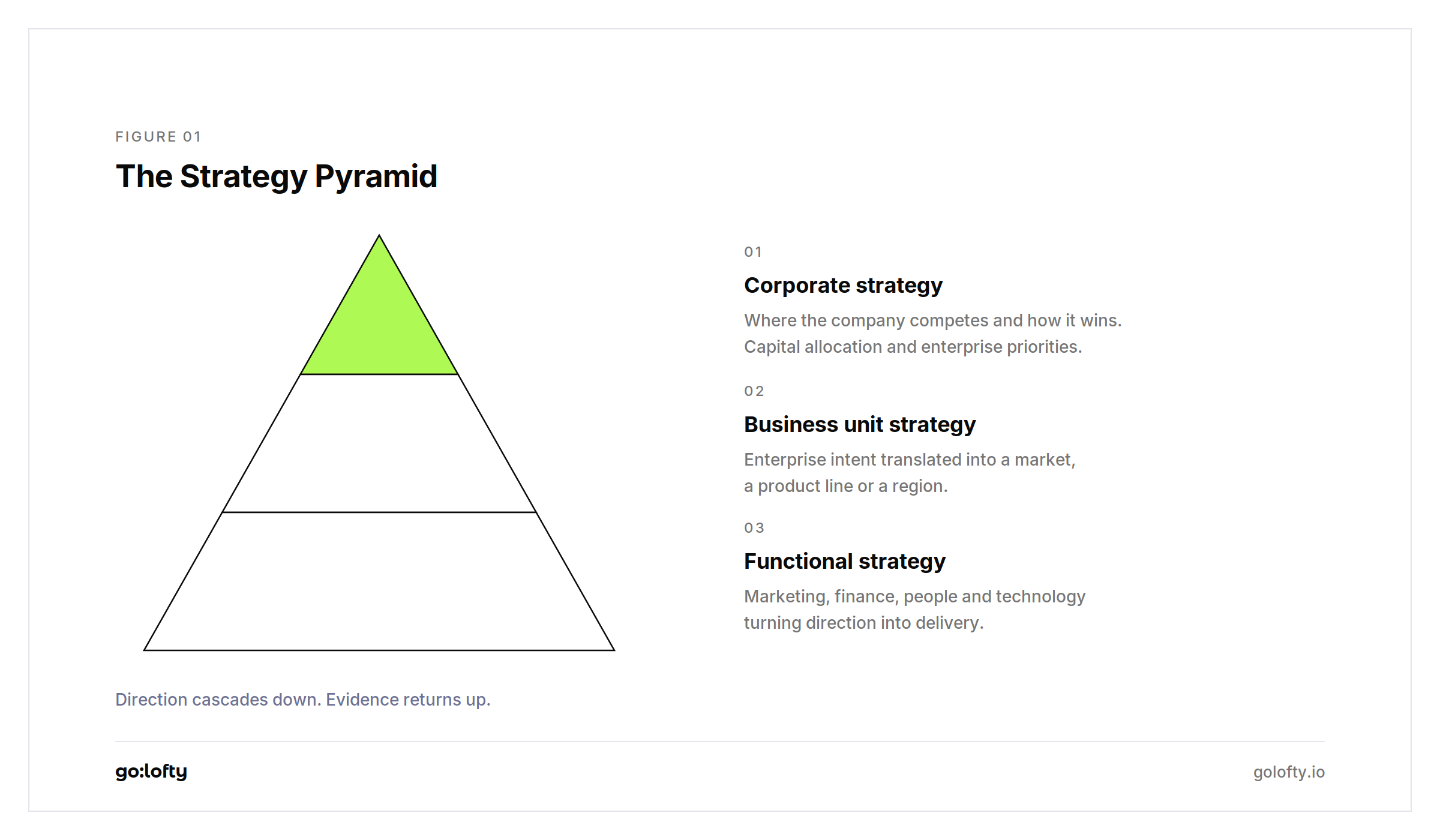
The Strategy Pyramid is a visual and conceptual model that illustrates how strategy flows through an organization, from the boardroom to the front line. It creates a common language for strategic intent, ensuring that every layer of leadership understands its unique role in delivering the company's vision.
In most organizations, strategy operates across three levels.
Corporate Strategy: top of the pyramid
This is the long-term vision set by the C-suite and board of directors. It defines where the company will compete across markets, geographies and segments, and how it will win through differentiation, innovation and partnerships. Corporate strategy sets the direction, allocates capital and determines the overarching priorities for growth, profitability and market leadership.
Business Unit Strategy: middle layer
This is where corporate intent becomes practical. Business units interpret the enterprise vision within their domain, whether a product line, service or regional market. They define competitive positioning, customer focus and specific growth levers. A consumer goods company may set an enterprise goal of global digital leadership, while its beverage division focuses on e-commerce expansion in APAC.
Functional Strategy: base of the pyramid
The foundation of the pyramid translates strategic goals into operational execution. Departments such as marketing, finance, HR and IT create tactical roadmaps aligned with business-unit priorities. Marketing may launch digital campaigns; HR may deploy leadership training to support transformation; IT may roll out automation to increase efficiency. Functional strategies ensure that operations, talent and systems all move in the same strategic direction.
The power of the Strategy Pyramid lies in clarity and alignment. It eliminates fragmentation, ensuring that every decision, initiative and investment ladders up to a shared purpose.
How does the Purpose-Strategy-Execution Pyramid connect vision with action?
While the Strategy Pyramid focuses on organizational structure, the Purpose-Strategy-Execution Pyramid explains how strategic thinking cascades from purpose to performance. It is a roadmap for turning intent into impact.
1. Purpose: the why behind the strategy
At the top sits the company's purpose, built around its mission, vision and values.
- Mission defines the organization's reason for existence, the problem it solves and the value it delivers.
- Vision describes the future the company aspires to create.
- Values guide behavior and decision-making, shaping the culture that sustains strategy.
Purpose anchors strategy. It ensures that every decision, from product innovation to market expansion, serves a larger organizational why.
2. Strategy: the how that defines direction
This layer answers a single question: how will we get there? It includes:
- Strategic intent, the company's overarching ambition such as digital leadership, sustainability or customer intimacy.
- Strategic drivers, key focus areas such as market share growth, innovation pipelines or operational excellence.
- Enablers, the resources, talent and partnerships needed to make strategy possible.
This is where purpose becomes tangible: a set of choices about where to compete, how to differentiate, and which priorities will drive advantage.
3. Execution: the what that turns strategy into measurable results
Execution brings strategy to life. It defines specific initiatives, targets and KPIs that translate the strategy into actionable plans.
- Initiatives turn abstract goals into programs and projects.
- KPIs and dashboards track progress and enable accountability.
- Strategy maps visualize how objectives and initiatives interconnect, showing teams how their actions contribute to corporate success.
This final layer ensures that strategy does not end at the planning stage. It becomes embedded in daily decision-making and performance management.
Why do these frameworks matter now more than ever?
The Strategy Pyramid and Purpose-Strategy-Execution Pyramid provide structure in a time of complexity. Modern organizations face faster cycles of disruption, hybrid workforces and rapidly changing customer expectations. These frameworks help leaders balance agility with alignment, adapting to change without losing coherence.
- Clarity: every level of the organization knows its role in achieving long-term goals.
- Consistency: strategic decisions align across departments, avoiding duplication and conflict.
- Focus: resources are directed toward initiatives that directly drive competitive advantage.
- Agility: with clear frameworks in place, organizations can pivot quickly when the market changes, without strategic drift.
These pyramids turn strategy from a conceptual idea into an operational system, something you can manage, measure and continuously improve.
How do the two pyramids work together in practice?
When integrated, these two frameworks create a closed strategic architecture:
- Purpose defines direction, why the organization exists.
- Corporate strategy translates purpose into ambition, what to achieve.
- Business unit and functional strategies define pathways, how to achieve it.
- Execution operationalizes the plan through measurable goals.
- Performance management ensures feedback loops that sustain alignment and learning.
A global pharmaceutical company might define its purpose as improving patient lives through accessible healthcare. Corporate strategy would focus on expanding R&D investment and emerging markets. Business units would tailor strategies to local needs, such as affordable generics in Africa and biotech innovation in Europe. Functional teams would align budgets, marketing and compliance processes with these priorities. Together, these layers form a strategy architecture that connects aspiration to execution.
Why embedding strategy as a function is a competitive advantage
Both pyramids reveal the same truth: strategy cannot succeed if it is treated as an event. It must become an ongoing function, an institutional capability embedded across the organization.
1. Continuity and alignment
A formal Strategy Function ensures strategy does not disappear after the annual retreat. It institutionalizes processes for analysis, planning, execution and performance tracking, maintaining alignment as markets evolve.
2. Strategic agility
In fast-moving industries, speed of decision-making is crucial. A dedicated strategy office gives organizations the ability to pivot without panic, updating priorities based on data rather than assumptions.
3. Cross-functional collaboration
By connecting the layers of the strategy pyramid, the strategy function acts as a central nervous system. It ensures that marketing, operations, HR and finance operate as coordinated forces delivering the same objectives rather than as silos.
4. Accountability and measurement
Embedding strategy across all levels creates a culture of ownership. Each leader knows how their performance contributes to enterprise-level goals, and success is measured through shared KPIs.
5. Sustainable growth
When strategy becomes a function rather than a document, organizations achieve sustainable competitive advantage. They evolve faster, execute better and stay aligned, even during disruption.
Practical tips for executives implementing the Strategy Pyramid
- Create a Strategy Office or Chief Strategy Officer role to coordinate between layers.
- Use quarterly strategy reviews instead of annual cycles to keep priorities current.
- Develop a company-wide strategy map linking corporate goals to departmental metrics.
- Communicate vertically and horizontally. Strategy must flow in both directions.
- Integrate technology such as BI dashboards and planning software to make performance transparent and actionable.
The goal is to make strategy visible, measurable and executable across every level, turning abstract goals into daily discipline.
The takeaway: from vision to execution
The Strategy Pyramid and Purpose-Strategy-Execution Pyramid are operational architectures for organizations that want to compete intelligently and sustainably, not academic models.
They remind us that strategy is about connection as much as direction: connecting purpose to vision, strategy to structure, and execution to measurable results.
When companies embed strategy as a function, they move from reactive to proactive, from fragmented actions to unified progress. They create the capability to adapt, scale and sustain growth in a constantly evolving market.
At go:lofty we build integrated strategy frameworks that connect corporate purpose with real-world execution. We help organizations establish Strategy as a Function, align teams around shared outcomes, and implement end-to-end strategy systems that drive measurable business impact.
Talk to us about building and operationalizing a unified strategy pyramid.