The Customer Engagement Infrastructure for the "Segment of One" Personalization

Segment of one describes an appealing end state: every customer treated as their own market, every interaction shaped by what that individual has done. Vendor architecture diagrams for it are impressive and largely identical.
The useful questions are different. How much of the available return sits in the first few steps rather than the last ones, what the infrastructure actually costs to run, how you would know whether it worked, and what the law permits. This covers those.
The personalisation ladder
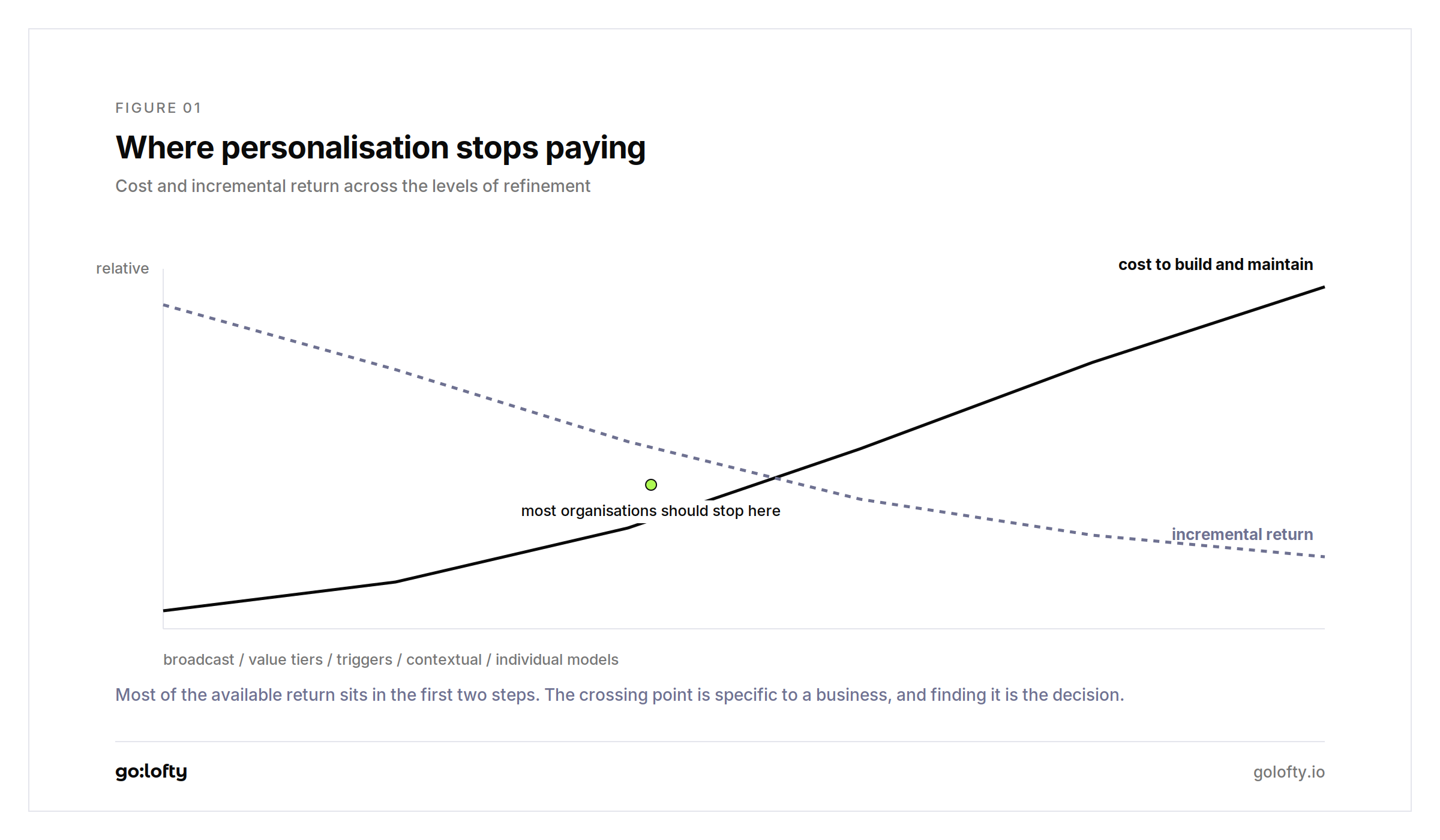
Personalisation is a ladder rather than a state, and the return is heavily concentrated at the bottom.
Broadcast. Everyone receives the same thing. The baseline.
Value tiers. A handful of groups defined by what customers are worth, receiving different offers, service levels and attention. Cheap to implement where a customer value model exists and usually the largest single improvement available.
Behavioural triggers. A small set of events prompting a specific response: basket abandoned, renewal approaching, usage threshold crossed, first value not yet reached. Each has clear commercial logic and each can be tested independently.
Contextual. Content adapted to channel, device, time or place. Moderate cost, moderate return, and it degrades quickly without maintenance.
Individual models. Recommendations generated per person from a model. Expensive to build and to keep working, and genuinely valuable in a narrow set of businesses: large catalogues, frequent purchase, plenty of behavioural data.
Most organisations should climb to the third rung, measure carefully, and stop unless the numbers argue otherwise. The economics are unfavourable further up: each additional level of refinement costs more to build and maintain while returning less, and past a certain point an incremental variant costs more in content production than it generates in revenue.
That point arrives earlier than vendors suggest and later than sceptics assume, and it is specific to a business. Finding it is the decision that matters.
Identity resolution is the hard part
Every architecture diagram opens with a unified customer profile as though it were a configuration step. It is the hardest part of the project.
The problem is knowing that the anonymous browser, the purchaser from last year, the person who emailed support and the mobile app user are one customer. In practice records are split across systems with different keys, email addresses change, households share devices, business customers have many contacts, and a substantial share of activity cannot be attributed to any known customer.
Two consequences follow. The realistic goal is high-confidence resolution for known customers and honest acknowledgement that anonymous traffic will remain anonymous. And no analytics layer compensates for weak identity: a recommendation engine fed a fragmented profile produces confident recommendations for a person who does not exist.
Budget accordingly. This is normally the largest line in the programme and it is normally underestimated.
Measurement, which is where most programmes deceive themselves
Reported personalisation results are usually wrong, and in a predictable direction.
The typical claim compares personalised campaigns to previous campaigns, or personalised segments to other segments, or the period after launch to the period before. Each comparison contains differences other than personalisation, and the estimate is inflated.
The correct method is a holdout: a randomly selected portion of customers who receive the undifferentiated experience, held out consistently, with the difference measured over time.
Holdouts are unpopular because they cost visible revenue and because they sometimes show that an expensive programme did very little. Both are reasons to run them. A programme that cannot demonstrate incremental revenue against a control group has not demonstrated anything, whatever the dashboards show.
Measure incremental revenue and margin. Engagement metrics such as open and click rates move easily and correlate weakly with money.
Privacy and law
This is the section vendor material tends to reduce to a sentence about compliance. In the EU it constrains the design.
Lawful basis. Under GDPR every processing purpose needs one. Profiling for personalisation generally rests on consent or on legitimate interest supported by a documented balancing test. The basis has to be decided before building, because it determines what data may be used and for how long.
Tracking consent. The ePrivacy rules require consent for most tracking technologies before they are placed. Behavioural personalisation that depends on tracking therefore depends on consent rates, which in practice means a meaningful share of visitors cannot be personalised to at all. Plan for the population you may lawfully address rather than the total.
Automated decisions. Article 22 gives individuals rights, including human review, where a decision is fully automated and produces legal or similarly significant effects. Product recommendations do not usually reach that threshold. Credit, eligibility and pricing decisions can.
Data minimisation. Collecting everything in case it proves useful conflicts directly with the principle. A defensible programme states what each field is for.
The concentration risk. A unified customer platform is a single high-value target and a single point of compliance exposure. Access controls, retention rules and the ability to answer subject access and erasure requests across the whole store are part of the build rather than an afterthought.
This is a summary and not legal advice; implementations should be reviewed by a qualified lawyer in the relevant jurisdiction.
Personalised pricing
Worth separating out, because it is commonly recommended and carries risk out of proportion to its benefit.
Since 2022 the Consumer Rights Directive, as amended by the Omnibus Directive, requires traders to inform consumers when a price has been personalised on the basis of automated decision-making. Disclosure tends to remove both the commercial effect and the trust. Differentiating by nationality or place of residence within the single market also runs into the geo-blocking rules.
Beyond the law there is the reaction. Customers who discover they paid more than someone else for an identical product respond badly and tell people, and the discovery is easy in a world of screenshots.
Differentiated offers, bundles, loyalty benefits and segment-specific promotions achieve much of the same commercial objective without the exposure, because they are understood as rewards rather than as discrimination.
The intrusion threshold
Personalisation stops being helpful at the point where it reveals inference rather than observation.
A recommendation based on something the customer did on your site reads as useful. A message demonstrating that you have inferred a life event, a health condition or a financial difficulty reads as surveillance, and the reaction is severe and lasting.
The workable rule: the customer should be able to reconstruct why they received this, from things they know they did. Where explaining the message would require describing a model, the likely damage exceeds the value of the conversion.
How these programmes fail
- Full architecture before proof. Every layer built, integrated and configured before anyone has shown a single personalised interaction produced incremental revenue.
- Content cannot keep up. The system can deliver a hundred variants and the team can produce eight, so most customers receive stale content dressed as personalisation.
- Personalising the wrong channel. Heavy investment in email personalisation for a customer base that mostly uses the app.
- Engagement as the measure. Open rates rise, revenue does not, and the programme continues for two years on that basis.
- Consent as a formality. A basis recorded rather than obtained, which fails on examination and puts the whole dataset in question.
Where to start
- Fix identity resolution for known customers. Unglamorous, foundational, and it will take longer than planned.
- Implement value tiers from the existing customer value model. Differentiate offers and service by tier.
- Add three behavioural triggers with clear commercial logic, each measured against a holdout.
- Establish the measurement discipline before extending anything: holdout groups, incremental revenue, honest reporting.
- Extend only where measurement shows a return, one step at a time.
That programme takes roughly a quarter, costs a fraction of a platform implementation, and captures a large share of what a full personalisation stack would deliver. It also produces the evidence needed to justify the next stage, if there is one.
The point
Segment of one is a direction rather than a destination, and the return is concentrated in the first few steps. Climb the ladder deliberately, measure each step against a holdout, and stop where the economics stop working.
Spend the money on identity resolution rather than on the analytics layer. Decide the lawful basis before building. Leave personalised pricing alone. And keep personalisation on the observable side of the line, because the trust it costs to cross is not recoverable.
At go:lofty we design customer engagement infrastructure around what can be measured and defended, which usually means a smaller build than the diagram suggests.
Talk to us about how far up the ladder your business should go.