Exploring the Space Tech Market: Ecosystem Structure, Niches, and Success Factors

The space sector attracts attention for the parts that photograph well: rockets, tourism, asteroid mining. The revenue sits somewhere else entirely, and confusing the two produces business plans aimed at markets the company cannot sell into.
This covers where the money actually is, what makes the sector structurally difficult, the regulatory regime most founders discover too late, and which segments a new European company can realistically enter.
Where the revenue is
Industry estimates put the global space economy at roughly 600 to 650 billion dollars, with forecasts suggesting it could pass a trillion within the next decade. Estimates vary by source and by what each counts, which is itself informative: a figure that swings by a hundred billion depending on definition should not anchor a strategy.
The distribution matters more than the total.
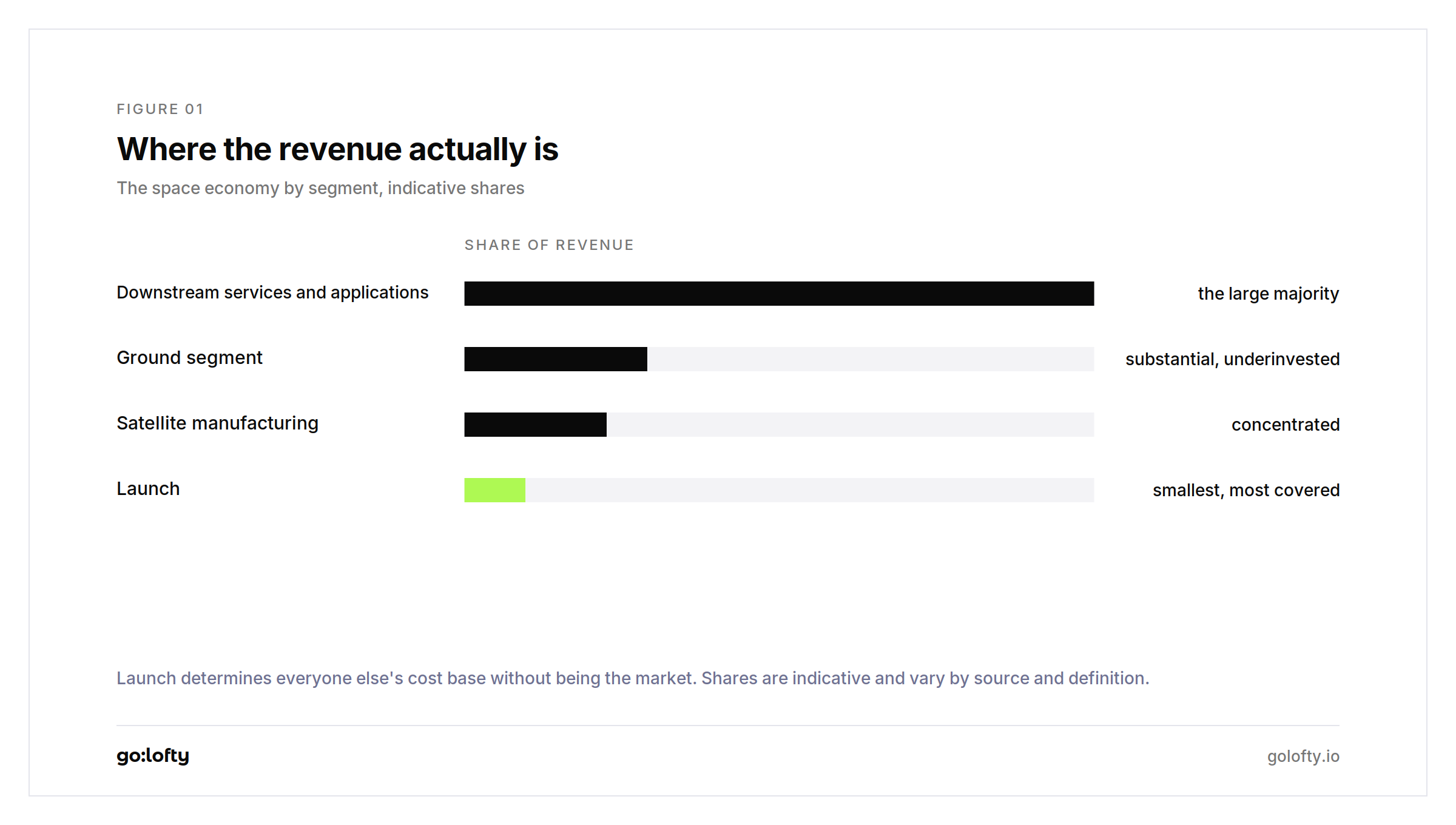
Downstream services and applications account for the large majority. Satellite television and broadband, navigation-enabled services, Earth observation data and everything built on top of it. This is where most revenue is earned and where the customer is usually a terrestrial business with an ordinary purchasing process.
Ground segment is substantial and persistently underinvested relative to the satellites it serves. Antennas, networks, mission operations software, data processing pipelines.
Satellite manufacturing is meaningful and concentrated among a limited number of established suppliers, with a growing tier of smallsat builders.
Launch is the smallest of the four in revenue terms while receiving most of the coverage.
That last point is the correction most founders need. Launch matters strategically because its cost determines what everyone else can afford to do, and falling launch prices changed which satellite businesses are viable. It is not where the revenue is, and it is among the hardest segments to enter.
What makes the sector structurally difficult
Capital intensity against fund timelines. A hardware programme can take five to seven years to first revenue. A venture fund has a ten-year life. The mismatch is structural, and it explains why space companies with a software or data component that earns revenue while the hardware matures raise more easily than pure hardware plays.
Lumpy milestones. Progress arrives in large discrete steps rather than incrementally, which makes the sector hard to fund in the tranches investors prefer and hard to manage against quarterly expectations.
Dependence on someone else's schedule. A satellite company's revenue starts when its payload reaches orbit, and launch dates slip. Cash burn continues through the slip. This is the most common way otherwise sound companies run out of money.
The demonstration gap. A prototype that works in a test campaign is a long way from hardware that operates unattended for seven years in a radiation environment with no possibility of repair. Most of the engineering cost sits in closing that gap, and it is routinely underestimated in plans built around the demonstration.
Customer concentration. Public agencies are the anchor customers in most segments. Their contracts confer credibility and their budgets change with political cycles a supplier cannot influence.
Export control, which arrives earlier than expected
This is the section most treatments of the sector omit, and it determines what a company can do before it determines how well it does it.
EU dual-use. Regulation 2021/821 governs dual-use items and covers a broad range of space and satellite technology. Licences are required for export outside the EU, and the regime extends to transfers of technology and software, including in some circumstances to employees who are not EU nationals working on controlled technology.
US regimes travel with the part. Components of US origin can bring a product within ITAR or the Export Administration Regulations regardless of where the company is established. A European satellite containing a US-controlled component inherits US constraints on where it may be sold and who may work on it.
The practical consequences are commercial rather than merely administrative. Classification constrains which suppliers can be used, which customers can be sold to, who can be hired, and in some cases which investors can take a stake. Determining the position early is considerably cheaper than discovering it during due diligence on a funding round or a sale.
This is a summary rather than legal advice, and any specific classification should be confirmed with a qualified export control adviser.
Segments a new entrant can realistically enter
Components and subsystems. European suppliers hold established positions here, and a specialist supplier can build a business without owning a spacecraft. The customer is another company in the chain, and the qualification burden is real but bounded.
Ground segment. Antennas, networks, scheduling, mission operations, data pipelines. Less glamorous than the flight segment, persistently underserved, and buildable with software economics.
Applications on space-derived data. Agriculture, insurance, maritime, energy, environmental compliance, defence intelligence. The customer is terrestrial, the sales cycle is ordinary commercial, and the space element is an input rather than the product. Most sustainable new European businesses in this field are being built here.
In-orbit servicing and debris. Genuine technical need, growing regulatory pressure, and a customer base that is still forming. Promising and early, which means the funding question is whether anyone will pay before the regulation requires them to.
Segments to be sceptical about
Space mining. No commercial revenue exists. Several prominent early companies ceased operations. The legal position under the Outer Space Treaty remains contested, and the economics depend on demand for materials in space that does not yet exist. Trillion-dollar projections for this segment are speculation rather than forecast, and repeating them costs credibility with anyone who knows the sector.
Space tourism. Real, operating, and small. Suborbital flights are sold and flown at prices that confine the market to a narrow customer base. It is a rounding error in the wider economy and attracts attention disproportionate to its size.
Neither observation means the segments are worthless. Both mean that a supplier business should not base a growth plan on them.
What qualification actually requires
Requirements follow the customer rather than the sector.
Institutional buyers commonly require quality management to ISO 9001, and European space projects generally reference the ECSS standards. Information security certification such as ISO/IEC 27001 is increasingly requested, particularly where data services are involved.
Where classified information is in scope, national security clearance for the company and for named personnel is a precondition. Clearance takes time, cannot be arranged retrospectively, and is frequently the reason an otherwise competitive supplier is ineligible rather than merely unsuccessful.
Check the specific requirement before committing to a bid. These are eligibility gates rather than scoring criteria, and no amount of technical merit compensates for failing one.
What to do about it
- Define the addressable segment, not the total market. The trillion-dollar figure is not a market you can sell into.
- Establish the export control position early. Classification determines suppliers, customers, hiring and investors.
- Plan cash against schedule risk, assuming a launch slip rather than treating it as an exception.
- Build revenue that does not wait for the hardware where the business model permits it.
- Pursue an institutional anchor customer and refuse to depend on one. The reference is valuable; the concentration is not.
- Cost the demonstration gap honestly. Reliability engineering is most of the programme, not the finishing stage.
The point
The space economy is large, and most of it is downstream of the parts that get photographed. Launch determines the cost base without being the market. Government money confers credibility and creates concentration risk. Export control constrains the business before commercial strategy does. And the segments with the most speculative valuations are the ones with the least revenue.
A company that is precise about which segment it serves, which regime governs it and how long the hardware will really take is unusual enough in this sector to be a competitive advantage.