What is Customer Centricity, Exactly, and How to Ensure You're on the Right Path?

Customer centricity is among the most agreed-upon and least precise terms in business. Almost every company claims it. Very few can say what they do differently as a result, which is the test that matters.
The term has a specific meaning, set out by Peter Fader in Customer Centricity and The Customer Centricity Playbook, and that meaning is considerably more demanding than the way it is usually used.
What it actually means
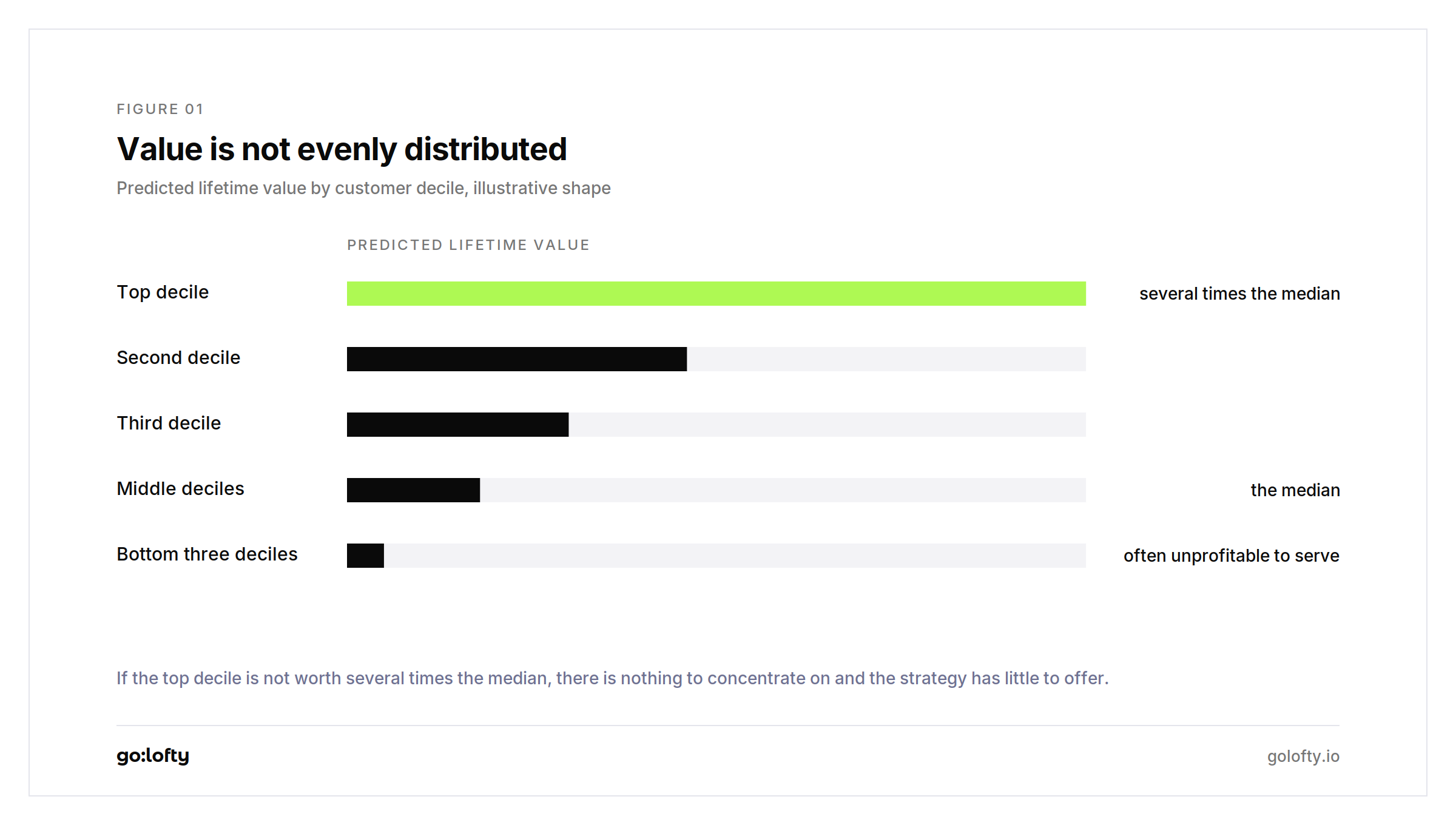
Customers differ enormously in the value they generate over their relationship with a company. In most businesses the difference between the top decile and the median is not twenty per cent; it is several times over. Customer centricity is the decision to allocate resources in proportion to that difference.
That makes it a resource allocation discipline rather than an attitude, and it carries a consequence people prefer not to state. If some customers receive disproportionate investment, others receive less. There is no version of this strategy in which everyone is served identically well, because that version is simply an even spread of resources over an uneven base.
What it is not
Three things are regularly mistaken for it, and the confusion matters because each leads somewhere different.
Excellent customer service. Companies celebrated for treating every customer superbly are usually pursuing operational or service excellence, which is a legitimate strategy and the opposite of this one. It spreads investment evenly. Both approaches work; they cannot both be pursued at full strength.
The customer is always right. A customer-centric company frequently declines requests from customers who are not worth the accommodation, and accepts costly ones from customers who are. The rule is not deference. It is differentiated investment.
Personalisation technology. Personalisation is a capability. A company personalising every message while investing equally across a base of wildly differing value has found an efficient way to execute an undifferentiated strategy. The decision about who is worth what comes first; the technology acts on it.
Customer lifetime value, properly
Lifetime value is the mechanism that makes the strategy operable, and it is usually described without enough precision to be usable.
The simple form. Expected gross margin per period, multiplied by a factor derived from the retention rate and the discount rate. A customer contributing 500 a year in gross margin, retained at eighty per cent, discounted at ten per cent, is worth roughly 1,300.
Two refinements matter more than the arithmetic.
Margin, not revenue. A customer generating substantial revenue while consuming heavy support, custom work and account management may be worth very little. Revenue-based value calculations systematically overvalue the demanding.
Predicted, not historical. Historical value records what someone has already spent, and decisions concern the future. Predicted value estimates what they will spend, from observed behaviour: how recently they purchased, how often, how much. A customer who spent heavily three years ago and has been dormant since has high historical value and almost no predicted value. Treating the two identically wastes the retention budget on people who have already left without saying so.
This is the point where Fader's work is more demanding than the popular version. The claim is not that companies should think about lifetime value in general terms, but that they should model it at the level of the individual customer and act on the distribution.
The precondition test
Before investing in any of this, three conditions decide whether the strategy has anything to offer.
Heterogeneity. Is the top decile worth several times the median? Where value is evenly distributed there is nothing to concentrate. This is checkable in an afternoon with existing transaction data, and it is the test most often skipped.
Identifiability. Can customers be told apart and recognised across purchases? A business whose transactions are anonymous cannot target anyone.
Actionability. Can groups genuinely be treated differently in service, pricing, product or attention? Where regulation, contracts or operations prevent differentiation, the analysis produces knowledge nobody can use.
Where all three hold, the approach pays for itself. Where one fails, the initiative becomes an expensive segmentation exercise that changes nothing.
What changes in practice
Acquisition stops maximising volume and starts targeting people who resemble existing high-value customers. That means acquisition cost limits set per segment rather than in aggregate, and campaigns judged on the value of who they brought rather than how many.
Service differs deliberately. Named account management for the top segment, responsive but standard support for the middle, self-service for the base. Stated plainly this sounds harsh; unstated, it happens anyway and at random.
Product weights requests by the value of who is asking. Not exclusively, since a feature requested by many small customers may open a segment, and as a standing input to prioritisation.
Reporting runs by customer cohort alongside product and region. Most companies cannot answer how much a cohort acquired two years ago is now worth, and the number is more informative than most of what appears in the monthly pack.
Low-value segments get reconfigured rather than removed. Most unprofitable customers are unprofitable because of how they are served, not who they are. Moving them to a cheaper channel converts a loss into a modest contribution, which is better commercially and better for them than being quietly neglected.
Customer equity and what the company is worth
The strategic argument that gives this weight in a boardroom is that customer value aggregates into firm value.
Customer equity is the sum of the lifetime value of the current base plus the expected value of customers not yet acquired. It connects behaviour to valuation: a company whose customer equity is rising while revenue is flat is in better condition than one where the reverse holds, and neither fact is visible in a conventional profit and loss statement.
Fader's later work on customer-based corporate valuation builds financial forecasts upward from customer behaviour rather than downward from revenue trends. For anyone raising capital or preparing for a sale, that framing is worth understanding, because a growing base of high-value customers is a different asset from the same revenue drawn from customers who churn.
Where the transformation usually stalls
Analysis without authority. Segmentation is produced, everyone agrees it is interesting, and no budget moves. The analysis was never attached to a decision.
Refusal to differentiate. The organisation accepts the analysis and cannot bring itself to serve customers unequally. Understandable, and it means the strategy has been declined rather than adopted.
Modelling on revenue. Value calculated on revenue rather than margin produces a top segment composed partly of expensive customers, and investment flows to the wrong people with full analytical confidence.
One-off exercise. Customer value shifts. A model built once and never refreshed is directing this year's spending using last year's customers.
When not to do this
Where customers are genuinely similar in value, which is true in many commodity and utility markets, there is nothing to concentrate.
Where purchases are rare and largely one-off, lifetime value approximates transaction value and the apparatus adds nothing.
Where regulation requires uniform treatment, differentiation may not be lawful.
And in an early-stage company with too few customers to model anything, the correct move is to serve everyone attentively and pay attention to which ones turn out to be good, which is how the distribution gets discovered in the first place.
The point
Customer centricity is a decision about where money goes, justified by the fact that customers differ in what they are worth. Test whether that difference exists in your business before doing anything else. Model value on margin and on prediction rather than on revenue and history. Accept that differentiated investment means some customers get less. Report by cohort. Refresh the model.
Done properly it changes acquisition, service, product and reporting. Done as a statement of intent it changes the wording on the website.
Talk to us about whether your customer base is actually heterogeneous.