How Can a Strategic Framework Empower Your Organization's Choices?

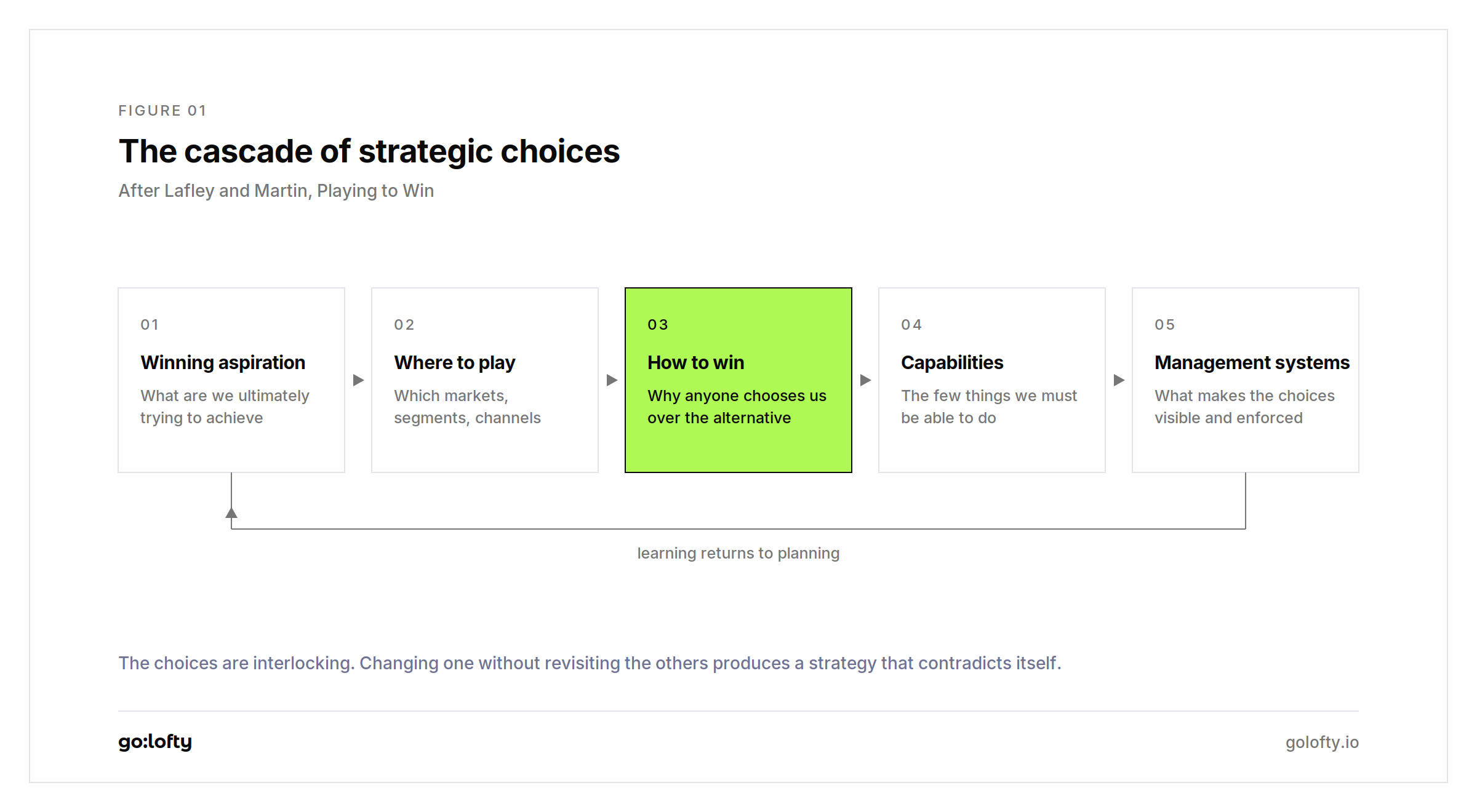
What makes a strategic framework essential for modern leaders
Organisations rarely fail because they lack ambition. They fail because their ambitions never crystallise into choices that can be executed across departments. A strategic framework addresses that gap. It provides a disciplined way to define purpose, choose markets, design competitive advantage and install the systems that ensure delivery.
For executives, the framework is more than a planning tool. It is the operating system of strategy. It ensures that every initiative, whether a digital transformation, a product launch or a market expansion, flows logically from the same foundation. Without that coherence, strategy collapses into a patchwork of projects with little cumulative effect.
The model set out below follows the cascade of five strategic choices developed by A.G. Lafley and Roger Martin in Playing to Win, which remains the clearest articulation of strategy as a connected set of decisions rather than a plan.
Defining a winning aspiration
Every framework begins with aspiration. This is not a financial forecast or a vague vision statement. It is the organisation's higher-order definition of success, and it answers a single question: what are we ultimately trying to achieve?
For some, the aspiration is market leadership in a defined category. For others, it is reshaping an industry or driving social change. Tesla's stated mission to accelerate the world's transition to sustainable energy is a clear example: it guides product decisions, partnerships and investment choices alike.
Aspirations should be ambitious and anchored in reality. One that is too narrow will fail to inspire; one that is too broad will fail to guide decisions. The right aspiration works as both a north star and a filter.
Choosing where to compete
Once the aspiration is clear, the next challenge is focus. No organisation can compete everywhere. Leaders must define where to play: geographies, customer segments, product categories and stages of the value chain.
This is often the hardest choice, because it requires saying no. Without boundaries, organisations spread themselves thin and lose advantage. Spotify began by playing in digital streaming for digitally native consumers and resisted the temptation to compete in physical distribution. That narrow decision created the scale and credibility which later enabled global expansion.
The discipline of where to play ensures resources go to markets where the organisation can genuinely differentiate.
Deciding how to win
Participation is not enough. Leaders must define how to win, which means articulating why customers, clients or partners will choose this offering over the alternatives.
Winning rests on a distinctive value proposition supported by a credible business model. IKEA won not on low cost alone but on the integration of affordable design, flat-pack logistics and an in-store experience that turned furniture shopping into an outing.
Executives have to translate intent into a proposition that resonates. Without that clarity, an organisation can be active in attractive markets and still hold no edge in any of them.
Building the capabilities that deliver
No strategy succeeds on ambition alone. Execution depends on capabilities: the organisational muscles that bring choices to life.
These are specific to each strategy. A pharmaceutical company may need clinical trial management and regulatory affairs expertise. A software business may need product-led growth capability and rapid deployment. Apple's design and ecosystem integration are not generic strengths; they are tailored to its chosen way of winning.
Leaders should invest disproportionately in the few capabilities that make their how-to-win real. Building everything is impossible. Building the right things is decisive.
The management systems that sustain alignment
Even with aspiration, choices and capabilities defined, strategy will fail without systems to sustain alignment. Management systems are the mechanisms that measure performance, reinforce priorities and enable adaptation.
Balanced scorecards, OKRs, CRM platforms, marketing automation and compliance programmes are infrastructure rather than tools. A defence contractor cannot execute credibly without rigorous compliance systems. A digital-first company cannot scale without analytics informing decisions in near real time.
The strength of a system lies not in the software but in its ability to make choices visible and enforce discipline across the enterprise.
The five choices in sequence
- Winning aspiration. Define purpose and guiding goals, and align ambition with board and investor expectations for growth and trajectory.
- Where to play. Identify the playing fields: geographies, product categories, customer segments, channels and stages of value creation. Choose the markets where the opportunity is greatest.
- How to win. Articulate the business model, value proposition, competitive advantage and positioning, and connect offering and pricing to the sales and marketing approach.
- Capabilities to win. Build the skills and resources required: strategic initiatives, specialist competencies, recruitment and development plans, and an offering configured to fit the strategy.
- Management systems. Establish the supporting infrastructure: CRM, marketing automation, analytics, decision mechanisms, skills management and compliance. These ensure choices are executed consistently and measured properly.
Together the five questions form an integrated framework. Its power is that it is comprehensive and adaptable at the same time, guiding deliberate choice while leaving room for iteration as conditions change.
Why a framework future-proofs the organisation
Markets are not static. Competitors move, regulations shift, technologies disrupt. A rigid strategy risks obsolescence; a well-designed framework creates resilience. Netflix began with DVDs, moved its where-to-play to streaming, and later into original content. The aspiration stayed constant, entertainment for global audiences, while the choices evolved.
The test of a framework is whether it can absorb shocks and redirect the organisation without losing coherence. That adaptability is the difference between a strategy that lasts and one that fades.
Strategy as a living system
Strategy is not a document. It is a set of living choices that must be translated into action every day. A framework provides the architecture for those choices: clear aspiration, deliberate focus, competitive logic, capabilities and systems.
The imperative for executives is to treat strategy as a function rather than an event. With a robust framework, organisations can compete with confidence today and adapt with resilience tomorrow.
Talk to us about turning your choices into a working framework.